 Yield
YieldLearn how crypto yield actually works
Plain words: how CeFi and DeFi work, how stablecoins differ, how to read risk, what to look for in a pool.
New guides most weeks, plus a Monday digest of the best rates. No spam.
Subscribe via RSS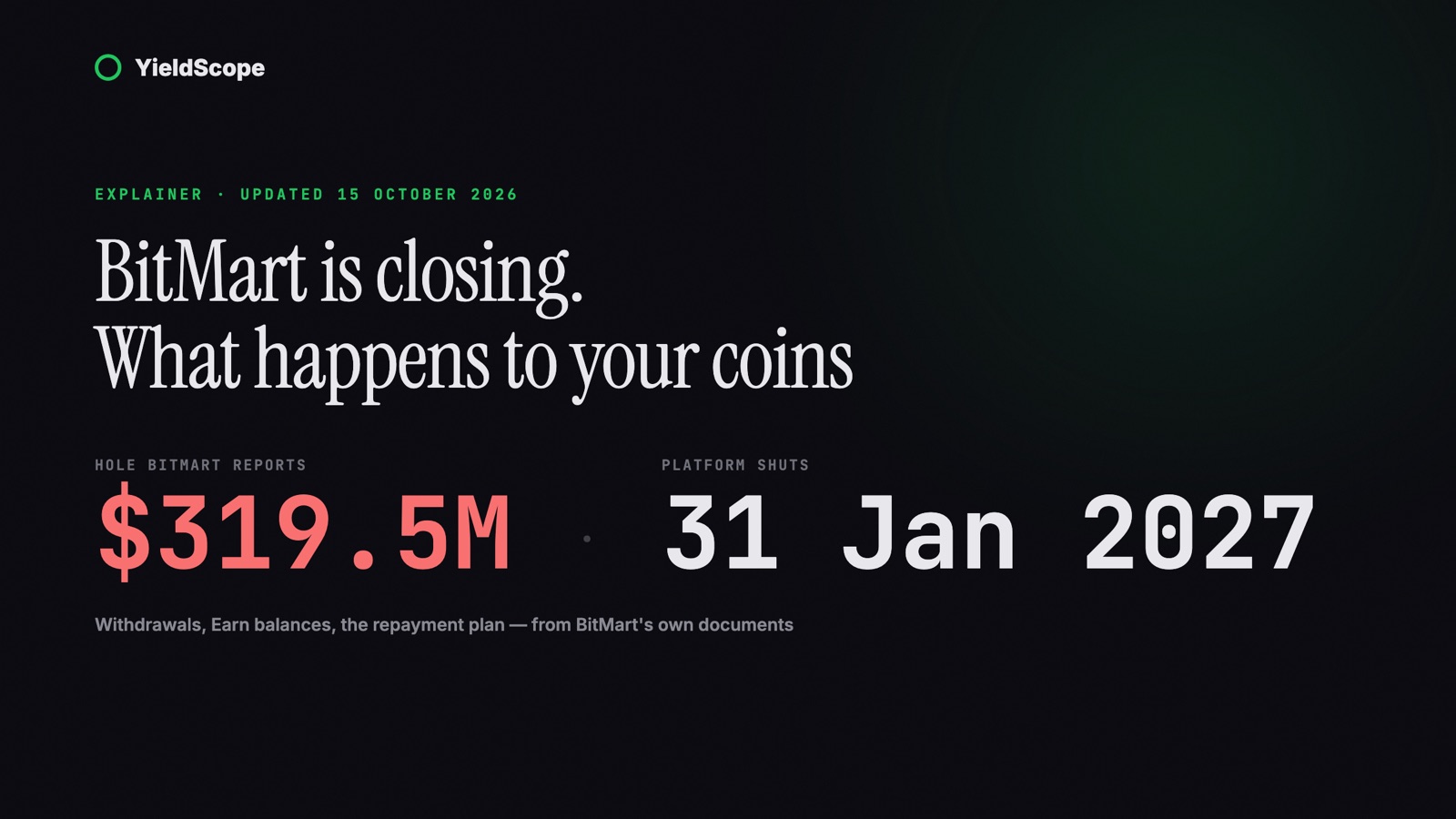
BitMart Is Closing: What Happens to Your Coins, Earn Balances and Withdrawals
BitMart is winding down: trading stopped on August 26, 2026, and the platform shuts on January 31, 2027. What the exchange itself says about withdrawals and Earn products, where its $319.5 million hole comes from, and the three repayment options it proposes — from its own documents.
Read →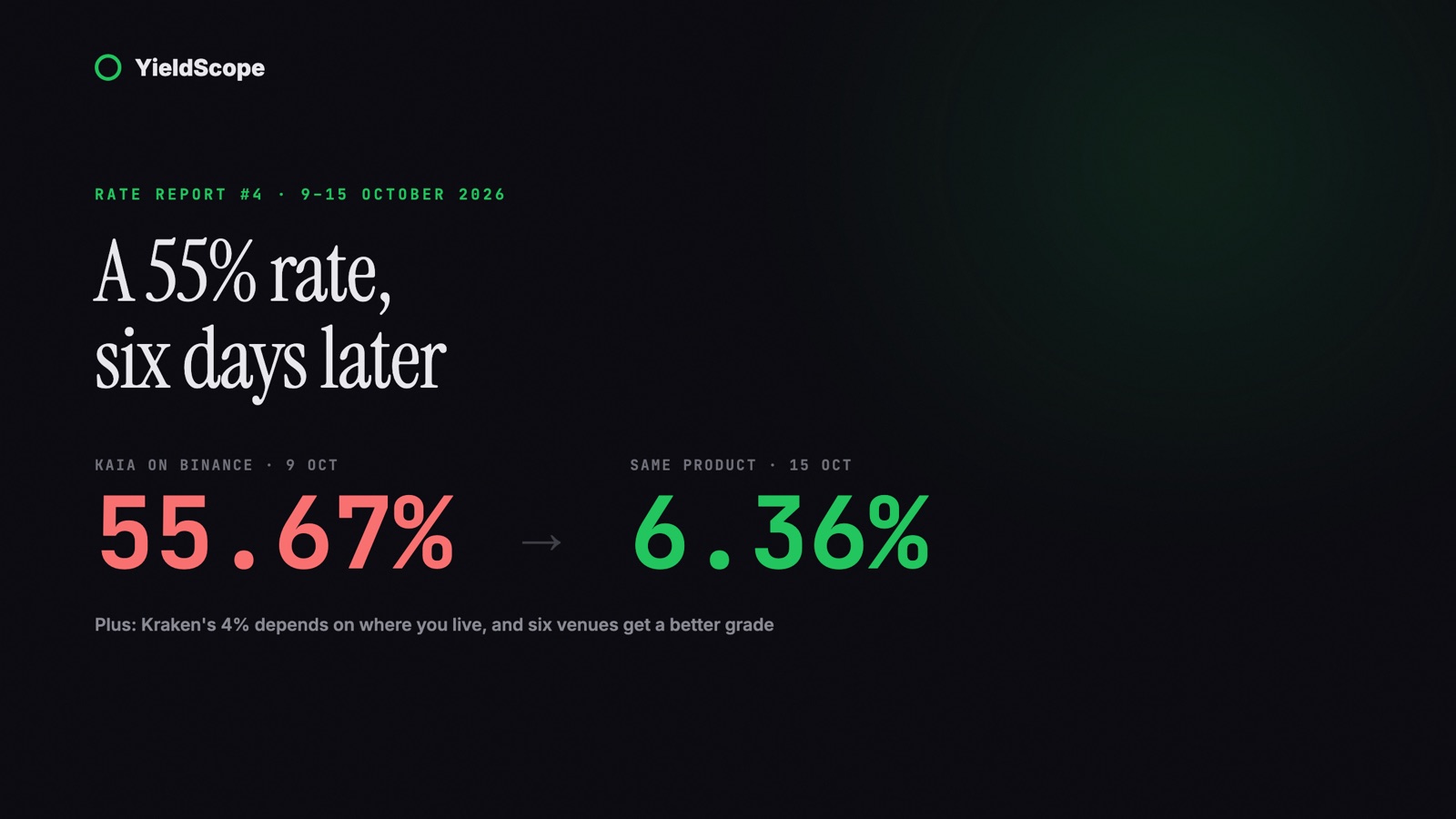
YieldScope Rate Report #4: A 55% Rate, Six Days Later — and Why Kraken's 4% Depends on Where You Live
Fourth issue of our crypto-rate report, October 9–15, 2026: KAIA's flexible rate jumped to 55.67% on Binance and 73.60% on Bybit, then melted within days; Kraken's 4% on USDT is closed in the UK, Australia, Canada, the EEA and to US retail clients; the week's biggest moves, six venues with a better grade, and our corrections.
Read →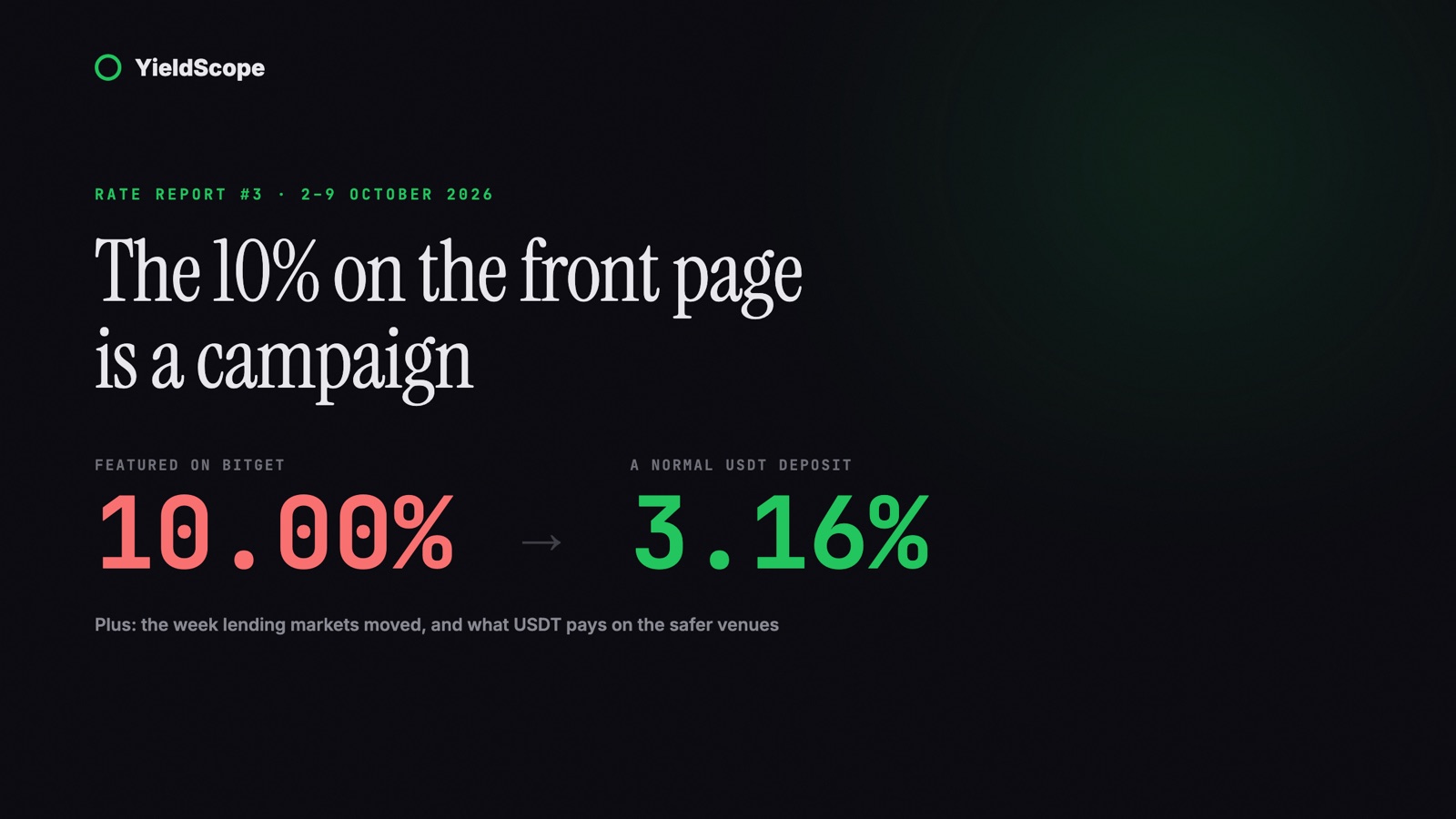
YieldScope Rate Report #3: The 10% on Bitget's Front Page Is a Campaign — and Lending Rates Swung 100 Points in a Week
Third issue of our crypto-rate report, October 2–9, 2026: Bitget's featured USDT 10%, USDC 8% and USDGO 12% are a campaign — the ordinary product pays 3.16%, 1.95% and 4.00% beyond the first slice. Plus the week's biggest moves (eight of ten on OKX's lending market), what USDT pays on B-grade venues (1–4%), and our corrections.
Read →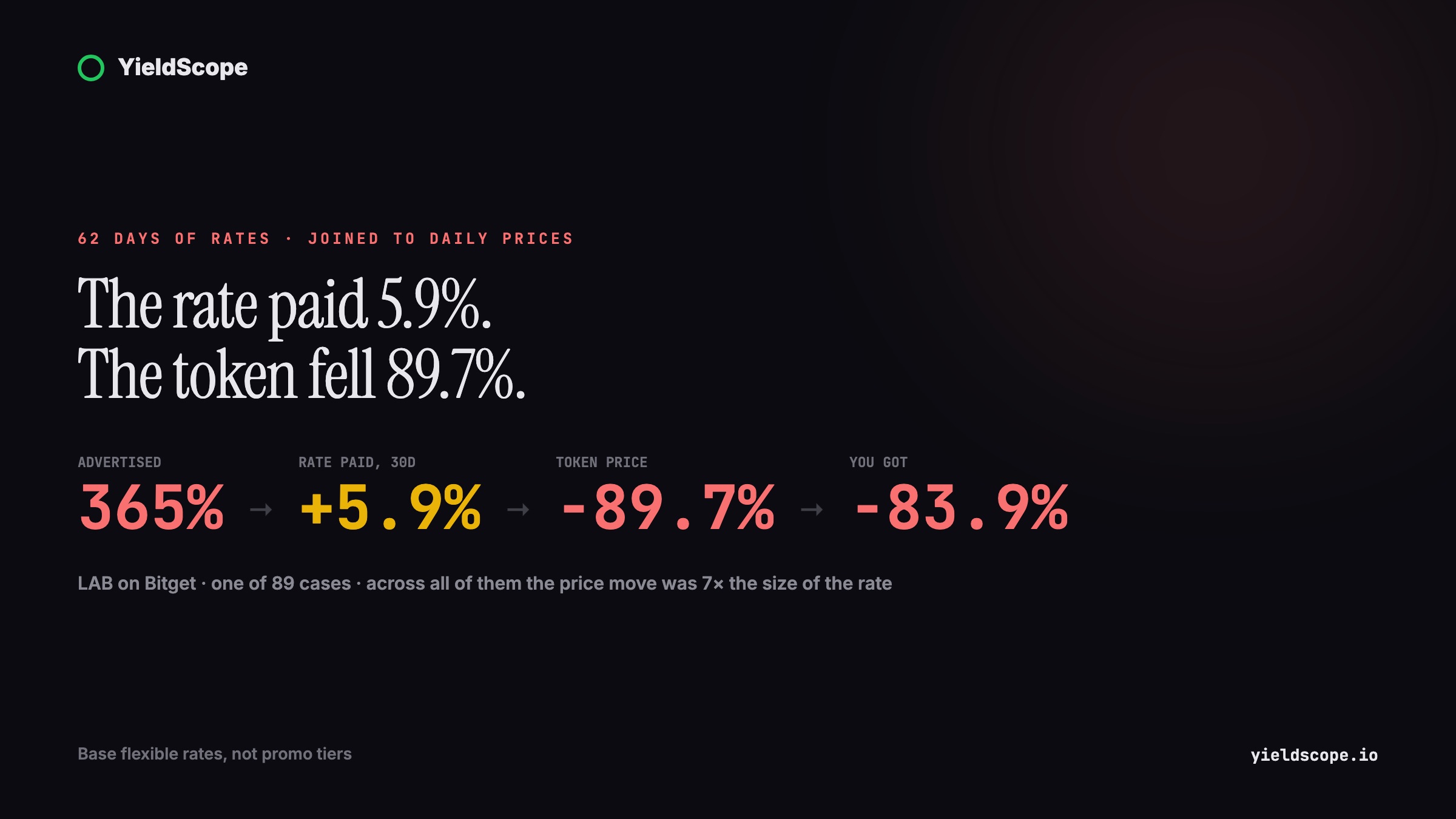
A 365% rate paid 5.9%. The token fell 89.7%.
We logged 167,987 earn rates on 38 venues over 62 days, then joined them to daily prices. A rate above 50% loses half of itself in two days — but that is the small half of the story. Counting the token's own price, the median position ended at −1.7% and 60% finished down.
Read →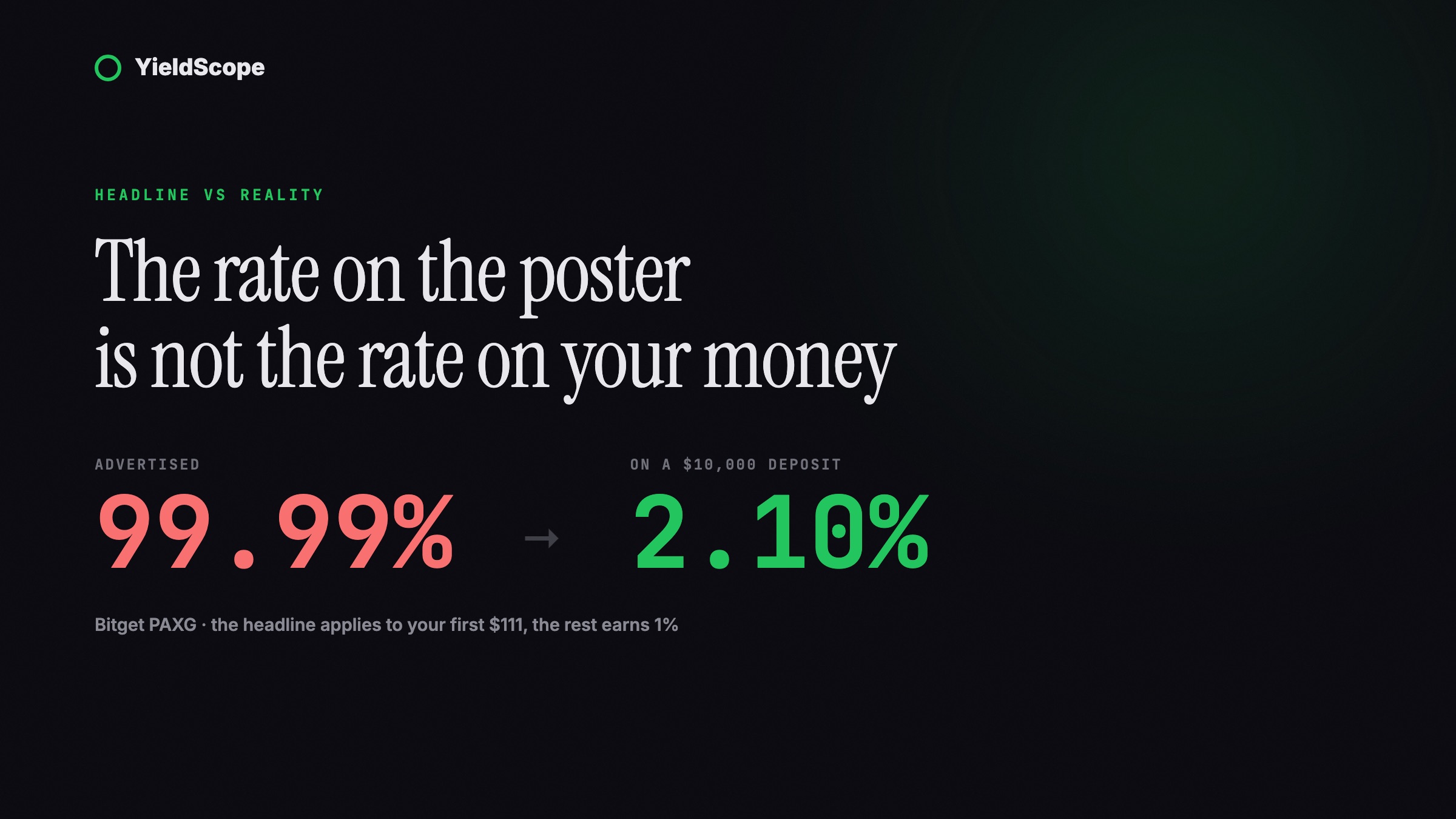
The rate on the poster is not the rate on your money
Nine of the 77 savings accounts we track pay effectively nothing by default — while advertising up to 5.85%. Crypto exchanges run the same trick through size: Bitget's 99.99% applies to your first $111 and turns into 2.10% on a $10,000 deposit. What the gap looks like, and how to read a headline in ten seconds.
Read →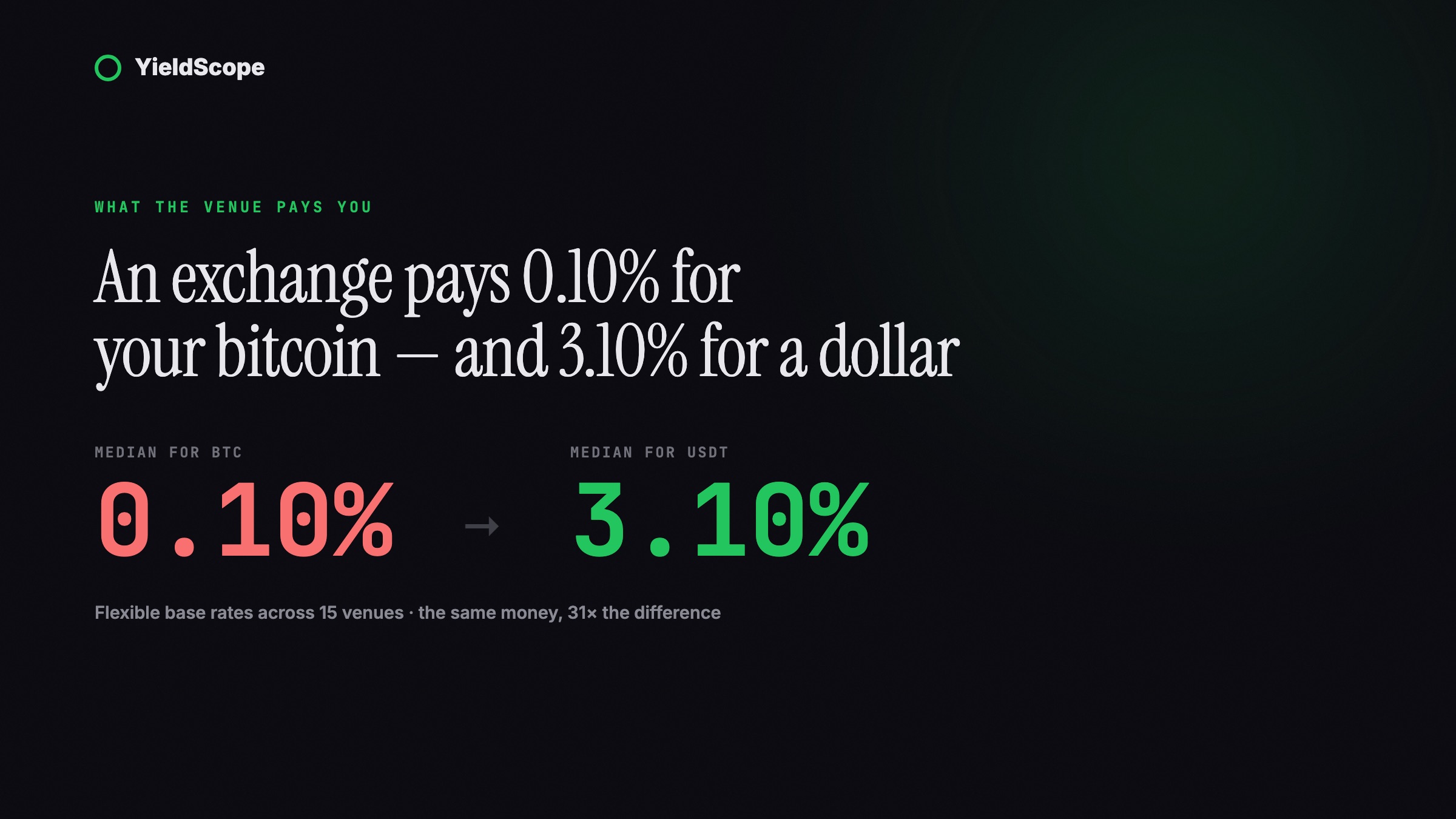
An exchange pays 0.10% for your bitcoin, and 3.10% for a dollar
Across 15 venues the median flexible bitcoin rate is 0.10% a year; for a dollar stablecoin it is 3.10%. Same account, same terms, 31 times the difference. Why the gap exists, why only F-graded venues pay 12% on BTC, and why the typical coin on Binance earns under 1%.
Read →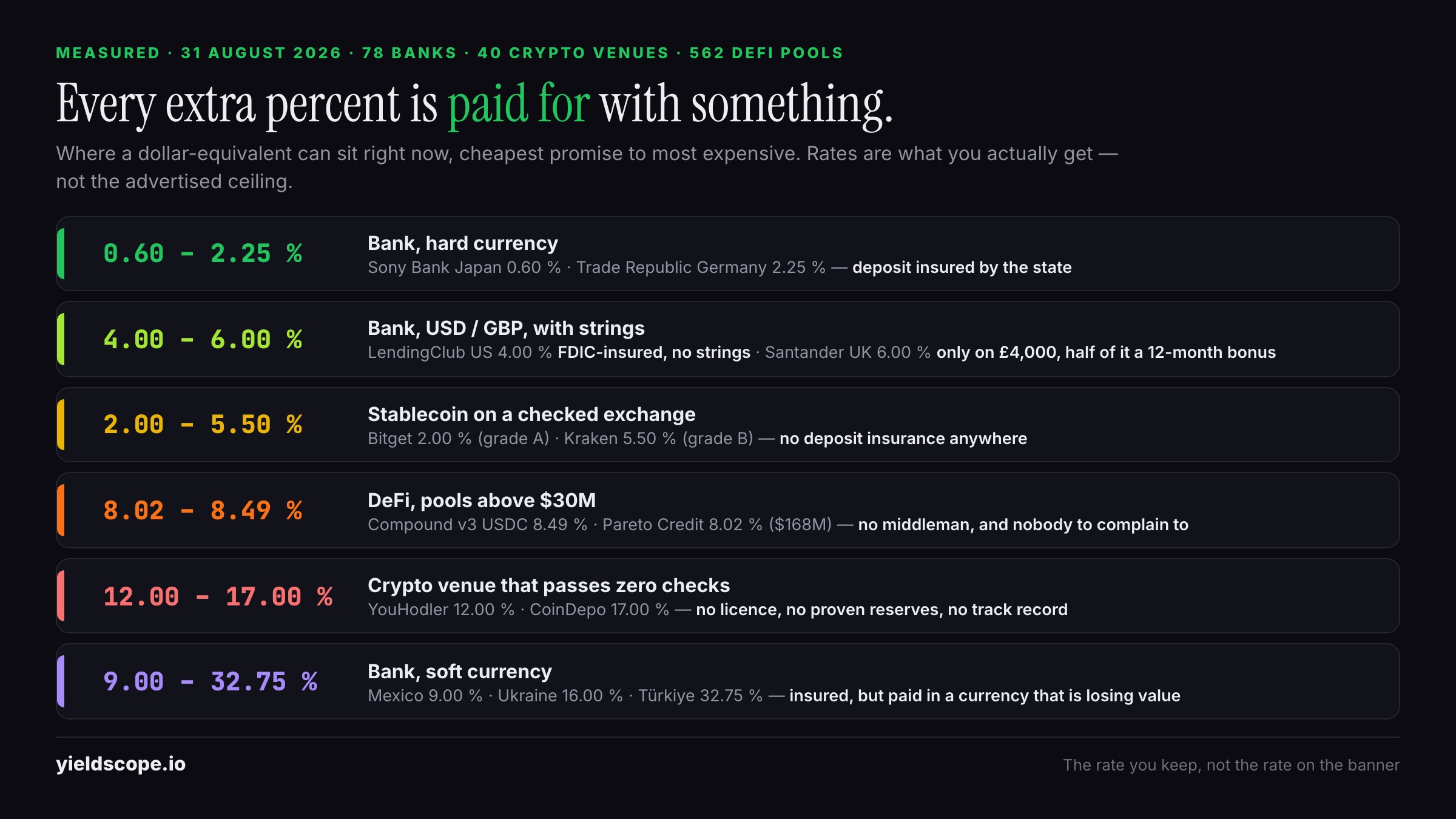
From 0.60% to 32.75%: where money can sit right now, and what each step costs you
We measured 78 banks in 19 countries, around 40 crypto venues and 562 DeFi pools with one fixed rule. On 1 September 2026 a safe dollar pays about 4.00% and the highest state-insured rate anywhere is 32.75% — in Turkish lira. Here is the whole ladder and the price of every rung.
Read →
Proof of reserves and insurance funds: what 37 crypto venues actually have
13 of 37 venues publish proof of reserves and hold an insurance fund; 9 have neither. But each phrase covers four different things — self-funded reserves, real third-party policies, narrow guarantees, and buffers that aren't insurance at all.
Read →
Is Nexo safe? The five checks, the two it fails, and what that costs you
Nexo grades C on YieldScope: it passes three of five safety checks and fails two. Every claim sourced — the SEC settlement, the Sofia raid, the $775M insurance and the daily reserve attestation.
Read →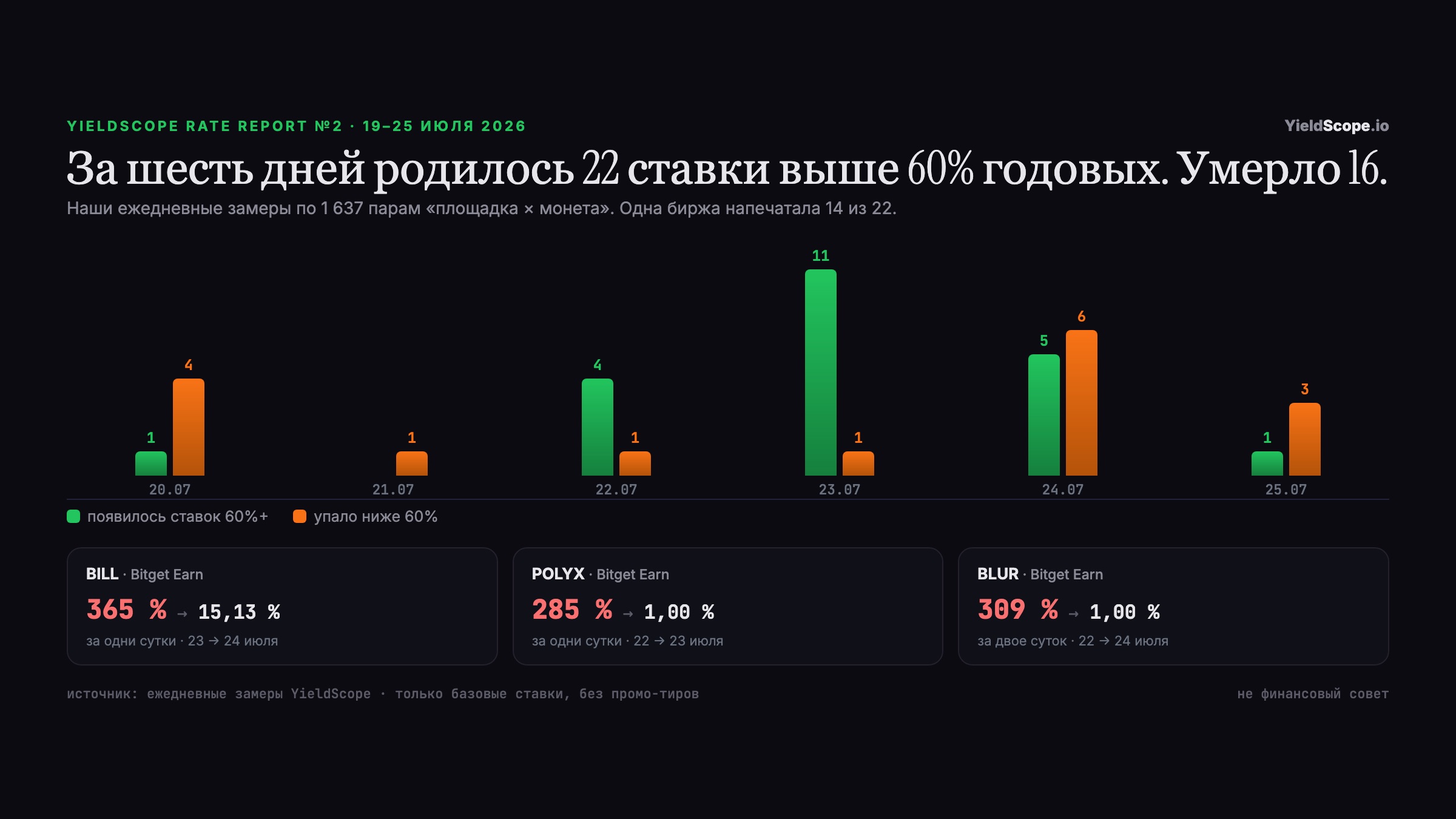
YieldScope Rate Report #2: 22 Rates Crossed 60% APY in Six Days and 16 Died — One Venue Printed 14 of Them
Second issue of our crypto-rate report: between July 19 and 25, 22 rates crossed 60% APY and 16 fell back; BILL on Bitget held 365% for exactly one day before becoming 15.13%; live triple-digit rates grew from 7 to 10. Plus a new metric — how long a rate actually survives: Kraken has not touched its USDT rate in 31 days, Binance changed its own 41 times in 47.
Read →
60 Days and 44,296 Snapshots: What the Data Actually Says About Crypto Yield
For two months we logged every rate across 37 platforms daily. The results: 126 rates spiked above 60% APY — 67% died within a day; the record 499% lasted one day; 30% of rates never changed at all; the median F-graded rate is 12× the A-graded one. Full breakdown with numbers.
Read →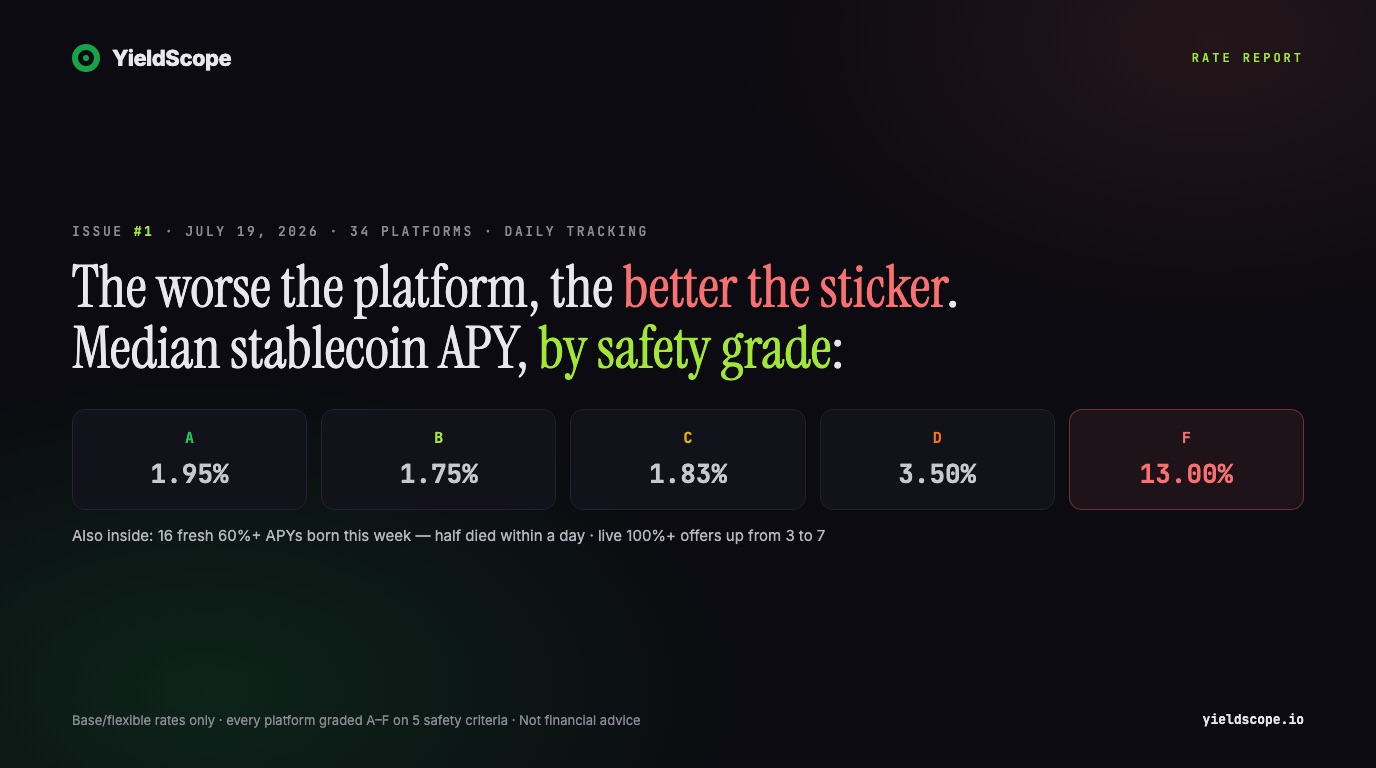
YieldScope Rate Report #1: F-Graded Platforms Pay 6.7× the Median Stablecoin Rate of A-Graded Ones — and Why That's a Warning
First issue of our recurring crypto-rate report: median stablecoin APY is 13% on F-graded platforms vs 1.95% on A-graded; half of the 16 fresh 60%+ rates died within a day (DATA on Bitget did it three times in one week); live 100%+ APYs grew from 3 to 7. All numbers from our daily tracking of 34 platforms.
Read →
A War Week on the Markets: Stocks Broke, Crypto Barely Noticed — What It Means for Your Yield
The US–Iran war crushed Asian markets: KOSPI −9.95% with a trading halt, the Bank of Korea's first hike in 3.5 years, $286M liquidated in a day. Over the same week Bitcoin moved −0.2%, Ethereum rose +4.8%, and safe stablecoin rates kept paying. The old lesson: in a storm, the grade beats the APY.
Read →
The GENIUS Act bans stablecoin issuers from paying yield — so why are you still earning on USDC?
The US's first federal stablecoin law forbids issuers from paying you interest. Yet Coinbase still pays ~4% on USDC. Here's the loophole, what it means for safety, and where stablecoin yield is heading.
Read →
MetaMask now pays 4% on mUSD: a savings account in your wallet — or an unproven stablecoin with DeFi risk?
Consensys built a yield account into MetaMask: up to 4% on the new mUSD stablecoin via Morpho vaults, plus a Mastercard. We break down where the yield comes from, how 4% compares across every platform we track, and the risks behind the word self-custodial.
Read →
MiCA is live: the EU just redrew the crypto safety map — and the viral lists are wrong
From July 1, 2026, no EU license means no EU. Here's who actually made it, what the viral screenshots get wrong, and why it's really about the safety of your funds.
Read →
Open USD (OUSD) explained: the stablecoin that shares its yield — but not with you (yet)
140+ giants including Visa, Stripe and BlackRock launched a stablecoin that shares reserve yield. Here's the part the headlines skip: who actually gets paid.
Read →
Tokenized Treasuries vs exchange Earn: where should your $10K sit in 2026?
Tokenized US Treasuries just crossed $15B and now compete with exchange Earn. Government-grade ~3.35% vs 7%+ on a platform — same dollar, very different risk. Here's how to choose, safety-first.
Read →
DeFi yield isn't free: what 2026's hacks teach about lending risk
A $292M hack that triggered $9B of Aave outflows, a lender that shut down a year after its breach, a stablecoin contagion. 2026's DeFi lessons — and how to assess a yield before chasing it.
Read →
What MiCA's July 1 deadline means for where you earn crypto yield
On July 1, 2026 the EU's MiCA transition window closes. ~83% of formerly-registered crypto firms still lack a licence. What's real, what's hype, and what it means for safe yield.
Read →
Why a high-yield stablecoin can still go to zero: the msUSD depeg
On June 20, 2026 the msUSD stablecoin lost its dollar peg and fell ~85% after its reserve-verification provider walked away. What happened, why 'stable' isn't automatic, and how to spot the risk.
Read →
Pre-IPO OpenAI and Anthropic perps: what they are, and the risks behind the hype
Crypto platforms now let you trade OpenAI and Anthropic 24/7 with leverage, before they go public. Here's what these pre-IPO perps actually are, the real valuations, and the risks the banner skips.
Read →
Crypto loans explained — how to borrow against your coins
How crypto-backed loans work, CeFi vs DeFi, what rates to expect, and the one risk that matters most — liquidation. In plain words, with live rates.
Read →
How Much Can You Really Earn Staking ETH in 2026?
Real ETH staking yield is around 3% before fees — and the headline APY isn't what you keep. Why net return differs, how native vs liquid vs exchange staking compare, and what it adds up to in dollars. Not financial advice.
Read →
How to Earn Interest on Bitcoin in 2026: Rates, Risks & Honest Picks
Bitcoin has no native staking — any "interest on BTC" is lending or DeFi. The three real ways, what a fair rate looks like, why high numbers are a red flag, and how to pick a platform by risk. Not financial advice.
Read →
How to Stake Solana (SOL) in 2026: Rewards, Risks & Best Methods
SOL is proof-of-stake and staking pays around 6–7% — among the highest rewards of any major coin. The three ways (native, liquid, exchange), what it adds up to, and the risks. Not financial advice.
Read →
Is Crypto Staking Safe? The Honest Risk Breakdown (2026)
Staking can be one of the safer ways to earn — if you understand the risks. The five real risks (counterparty, lock-up, slashing, price, smart contract), exchange vs self-custody, and a checklist before you start. Not financial advice.
Read →
Liquid Staking Explained: stETH, rETH & the Real Risks (2026)
Liquid staking lets you stake and still hold a tradable token (stETH, rETH, JitoSOL) you can use in DeFi — yield without the lock-up. How it works, the real rate after fees, and the risks the headline skips. Not financial advice.
Read →
How crypto yield is taxed (staking, lending & DeFi)
In most countries you owe tax on crypto yield the moment you receive it, not when you sell. The "two taxable events" model, the phantom-income trap, how it varies by country, and three myths. Not tax advice.
Read →
The SpaceX IPO, fully decoded: the biggest listing ever — expectations, the first hours, and what comes next
A professional breakdown of the SpaceX IPO (June 12, 2026): what the market expected, the 24-year road to the listing, how the first hours of trading played out, and the full bull-vs-bear case. Verified numbers only.
Read →
Bybit Earn vs Binance Simple Earn: which is better in 2026?
An honest head-to-head of Bybit Earn and Binance Simple Earn: base rates on USDT/BTC/ETH, our A–F safety grade, and exactly where the two biggest exchanges differ on risk.
Read →
SpaceX IPO, one day later: the predictions, the reality, and did Musk win?
A clear recap of SpaceX's (SPCX) first trading day: priced at $135, closed at $161 (+19%), market cap ~$2.1T. Which predictions held up, the hidden risks, and how to get exposure now.
Read →
Telegram Wallet vs exchanges: should you earn your USDT inside Telegram?
An honest look at the Telegram Wallet: custodial wallet vs DeFi vaults, the real rates and risks, and when to stay versus add an exchange. No hype, with disclosure.
Read →
APY vs APR: what exchanges actually show you, and why it matters
APY vs APR explained in plain words: the formula, an honest comparison table, why exchanges prefer the bigger number, and what a beginner should actually check.
Read →
Counterparty risk: the one risk that matters most in crypto earn
When you park stablecoins on an exchange for yield, the biggest risk isn't the market — it's the exchange itself. FTX, Celsius and Mt.Gox cases, where yield comes from, and how to reduce the odds of losing funds.
Read →
How to compare APY and risk: a 5-check framework for picking a yield platform
Sorting by APY and picking the top row is a lottery. Five checks — license, Proof-of-Reserves, flexible withdrawal, insurance fund, incident history — plus a step-by-step algorithm for choosing a platform.
Read →
Stablecoin depeg risk: how digital dollars break, and how to pick safer ones
What a depeg is, whether USDT can lose its peg, and how safe USDC really is. Real cases of UST, USDC and USDT, what makes a stablecoin resilient, and what holders should do.
Read →
Bank deposit alternatives in 2026: what actually pays more, and at what risk
A ladder of alternatives to your savings account — from HYSAs and government bonds to stablecoin Earn and DeFi. Honest numbers on yield and risk at every step.
Read →
Bank deposit vs stablecoin yield: an honest side-by-side comparison
A deposit is insured but pays less. Stablecoins pay more but with no insurance. Risks, scenarios and the math on $10,000 — no sales pitch.
Read →
Stablecoin yield for beginners: how earning 5-15% on digital dollars actually works
A guide for people who have never held crypto. What a stablecoin is, where the 5-15% comes from, how it differs from a bank deposit, and how to start without rookie mistakes.
Read →
Where to keep dollars in 2026: 5 options compared, from bank to stablecoins
An honest comparison of 5 ways to park your dollars — cash, HYSA, T-bills, stablecoin Earn, DeFi. Yields, insurance, liquidity, risks for each.
Read →
Best stablecoin yield in 2026 — USDC, USDT, DAI
Where stablecoins earn the most right now in CeFi and DeFi. USDC, USDT, DAI compared across exchanges and protocols — risks and how to pick.
Read →
CeFi vs DeFi — where to earn on crypto in 2026
What's the difference between an exchange (CeFi) and a DeFi protocol, which risk is higher, who should pick what. In plain words.
Read →
USDC vs USDT — which stablecoin to pick in 2026
The two main stablecoins compared on reserves, transparency, liquidity, and depeg risk. Where each makes sense.
Read →
Proof-of-Reserves explained — what it is and why it matters
What Proof-of-Reserves is, how exchanges publish it, why it became a standard after FTX. Which exchanges do it honestly.
Read →
What is DeFi yield and how does it work
Where DeFi yield comes from, how lending differs from AMM pools, what APR/APY/IL/rewards mean. A newcomer's guide.
Read →
How to pick a DeFi pool without losing money
Step-by-step DeFi pool selection — from protocol checks to APY stability. A checklist to avoid rug pulls.
Read →