Yield
YieldBank deposit alternatives in 2026: what actually pays more, and at what risk
A ladder of alternatives to your savings account — from HYSAs and government bonds to stablecoin Earn and DeFi. Honest numbers on yield and risk at every step.

Your bank pays you less than inflation eats, and you're wondering what else is out there. The good news: there are real alternatives. The honest news: there is no free yield — every extra percentage point is paid for with extra risk, always. This guide is a ladder. Each step pays more than the last, and each step is riskier than the last. The goal is not to climb as high as possible — it's to figure out which step you actually belong on.
Why your deposit loses to inflation — and why that's normal
A bank deposit is not an investment. It's an insurance product. Government deposit insurance (FDIC in the US, similar schemes elsewhere) guarantees your money back even if the bank collapses. That guarantee has a price, and the price is yield: banks know insured depositors won't leave, so they don't have to compete on rates.
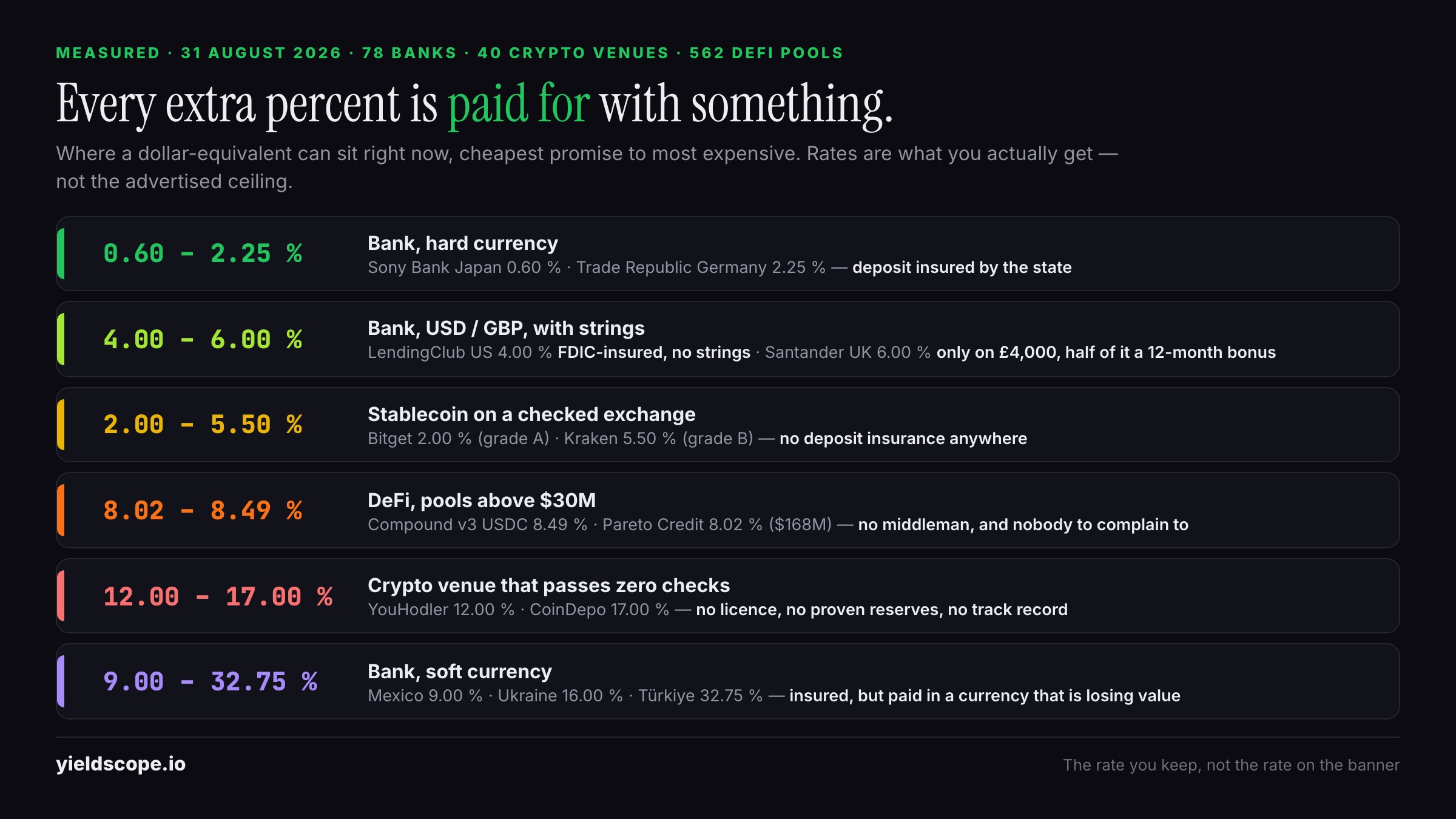
The typical 2026 picture: a deposit at a large bank pays 0.5-2% while inflation runs 2.5-4%. Your real return is negative — money in a deposit slowly loses purchasing power. That's not a conspiracy. It's the cost of taking zero risk, and for part of your money, zero risk is exactly what you want.
Here's the framing we'll keep coming back to: you don't replace your deposit — you supplement it. An emergency fund covering 3-6 months of expenses belongs somewhere insured and instantly accessible. Everything above that is a candidate for the higher steps.
Step 1: High-yield savings accounts — a bit more, same insurance
The most underrated alternative doesn't even require leaving the banking system. Online banks and neobanks offer high-yield savings accounts (HYSAs) paying 3.5-4.5% — with the exact same government insurance as your regular deposit.
Why the gap? Online banks have no branch networks to pay for and need to attract customers, so they compete on rate. Your legacy bank pays 0.5% because it can get away with it. Same insurance scheme, same protection, several times the yield.
The downsides are nearly cosmetic: the rate is variable (it will fall when central bank rates fall), and some accounts limit monthly withdrawals. The risk profile is the same as a deposit — effectively zero within insurance limits.
Who it's for: everyone. If your emergency fund sits at 0.5%, moving it to an HYSA costs twenty minutes of paperwork and nothing in risk. There is no reason not to take this step.
Step 2: Government bonds and money market funds
The next step is lending not to a bank but to a government. Short-term government debt (T-bills in the US) and money market funds yield 3.5-5% — comparable to a good HYSA or slightly above, and especially relevant for amounts that exceed deposit insurance limits.
Default risk on short-term debt of a developed country is considered minimal — this is the textbook "risk-free rate" that every other yield in finance is measured against. In some jurisdictions there's a bonus: interest on government debt gets favorable tax treatment.
The trade-offs: you need a brokerage account, money isn't instant (selling plus settlement takes a day or two), and longer-dated bonds do fall in price when rates rise. That's why beginners should stick to short maturities or money market funds, where that price risk is negligible.
Who it's for: people holding more than the insurance limit at one bank, or anyone who wants to lock a known rate for months or years ahead.
Step 3: Corporate bonds and dividend stocks
This is where genuine market risk begins. Investment-grade corporate bonds yield 4-6%, high-yield ("junk") bonds 6-9%. Dividend stocks pay 2-5% in dividends plus possible — but never guaranteed — price appreciation.
The fundamental difference from steps 1-2: the price can go down. A company can cut its dividend. A bond can lose value if the issuer gets into trouble. And in a broad market selloff, corporate paper falls together with everything else — being down 10-20% over a one-year horizon is normal behavior for this asset class, not a malfunction.
In exchange, you get returns that have historically beaten inflation over long horizons, inside a familiar, regulated infrastructure: licensed brokers, exchanges, audited financial statements, investor protections.
Who it's for: people investing for 3+ years who can watch a drawdown without selling — not people parking cash for six months.
Step 4: Stablecoin Earn on exchanges — 4.5-16%, with no insurance
Now the step YieldScope exists for — and we'll describe it with the same honesty as the previous four.
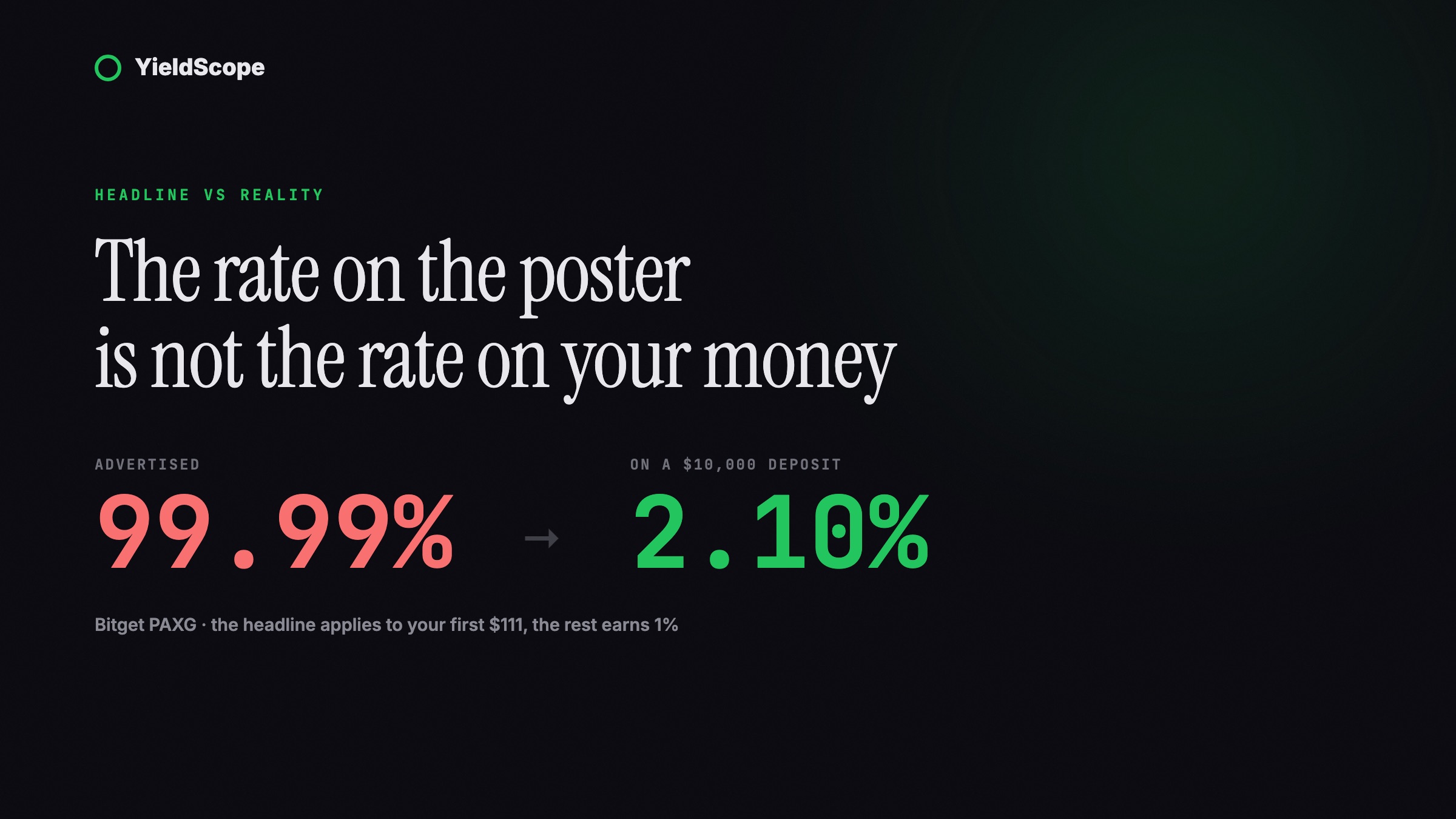
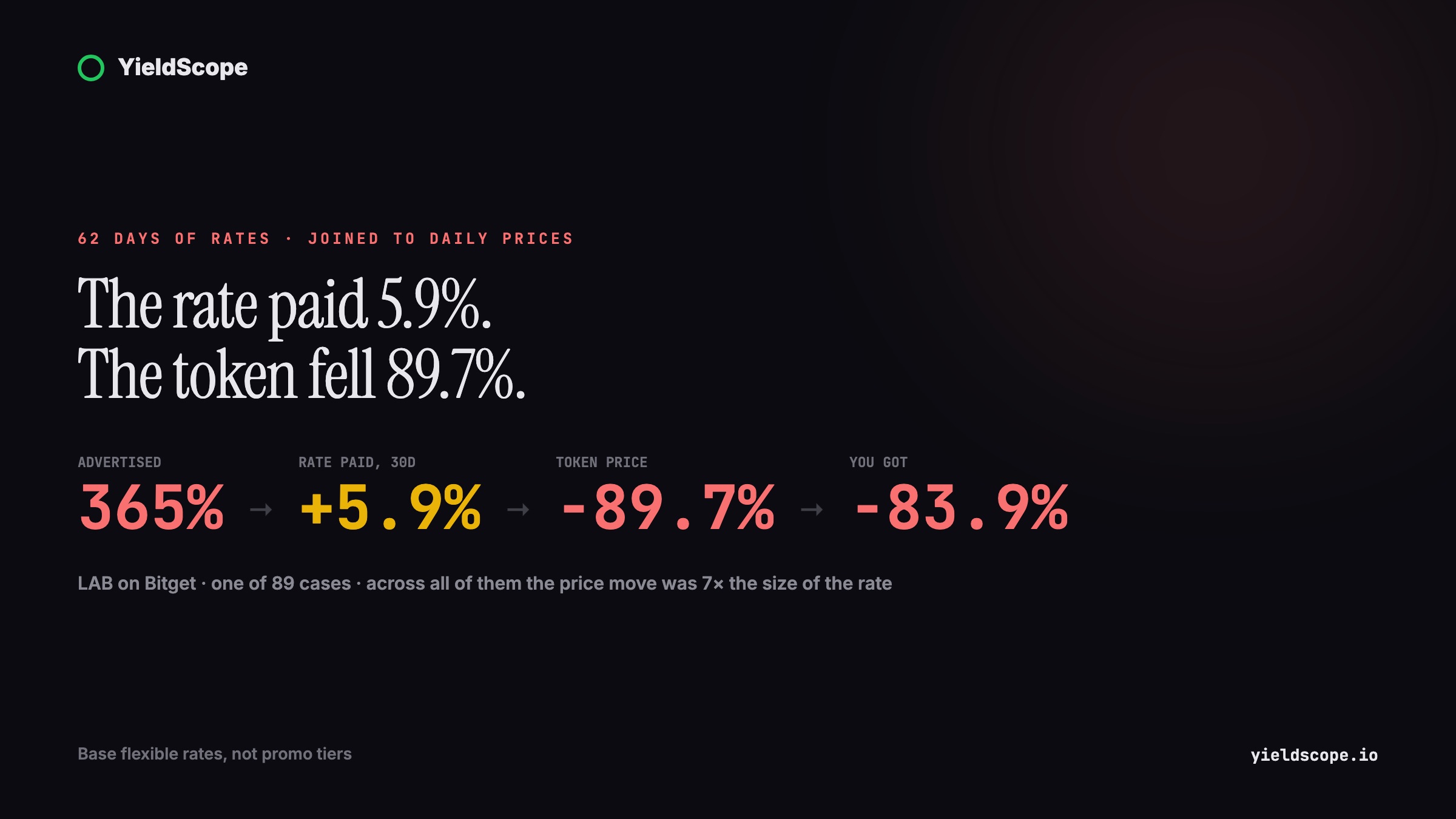
Stablecoins are tokens pegged to the dollar (USDC, USDT). Crypto exchanges pay you for depositing them into Earn programs: 4.5-16% APY, with flexible rates typically at 4-7% and promotional or locked programs higher. You can compare live rates across exchanges in our rate table.
Where does the yield come from? Not magic, and — at legitimate venues — not a Ponzi. Exchanges lend your stablecoins to margin traders and earn the spread; stablecoin issuers hold reserves in the very T-bills from step 2 and share that income. When demand for borrowed dollars rises in crypto markets, Earn rates rise with it. The yield is real; it's just not free.
What you pay for those percentages:
- No government insurance. None. If the exchange fails — FTX in 2022 is the canonical example — your funds can be gone. This is the headline risk, and it is not theoretical.
- Depeg risk: a stablecoin can trade away from $1. USDC dipped to $0.87 in 2023, USDT to $0.95 — both recovered, but holders who panic-sold locked in losses.
- Regulatory risk: rules change, and exchange access varies by country.
This is why we grade venues on risk criteria — Proof-of-Reserves, licensing, insurance funds, operating history — and show those grades right next to the rates. If you're new to this, start with our stablecoin yield guide for beginners and where to keep dollars.
Who it's for: people who understand and accept venue risk — and allocate only money whose total loss they could absorb.
Step 5: DeFi — higher still, for experienced users
Decentralized protocols (Aave, Curve, Morpho) pay 5-20%+ on stablecoins. There's no exchange in the middle: a smart contract holds the funds, no company can freeze your account, and rates are set by open markets.
But venue risk is replaced by smart-contract risk: a bug or exploit in the code can drain funds irreversibly, and there is no support desk to call. You also take on self-custody — wallets, seed phrases, network fees, and the very real possibility of expensive user error. This step is for people who are already comfortable on step 4, not a shortcut past it. More in our DeFi section.
The allocation rule: risk-free base first, risky alternatives only on the surplus
The ladder is not a route to the top. Here's the structure that actually works:
- Emergency fund, 3-6 months of expenses — steps 0-1: deposit or HYSA. Insured, instant.
- Medium-term goals — step 2: government bonds, money market funds.
- Only the surplus above that — steps 3-5, sized so that a total loss of the risky portion would not change your life.
And never — at any step — "everything in one place." Not in one bank above the insurance limit, not on one exchange, not in one protocol. Diversification is the only free risk reduction on this entire ladder; everything else costs yield.
To compare current rates across venues, start at the YieldScope homepage.
FAQ
Is stablecoin Earn just "a savings account with better rates"?
No. The interface looks similar; the substance isn't. A deposit comes with government insurance; Earn comes with none. The honest comparison: a deposit is a guaranteed return at a low rate, Earn is a higher rate in exchange for the risk of losing everything if the venue fails. Both are rational choices — for different portions of your money.
What yield is realistic right now without exotic risk?
2026 reference points: HYSAs and short government debt — 3.5-5%; investment-grade corporate bonds — 4-6%; stablecoin Earn at major exchanges — 4.5-8% flexible, more in locked programs. Anything promising a "stable 20%+ with no risk" is a reason to close the tab, not a deal to evaluate.
How much money do I need before going beyond an HYSA?
It's about structure, not size. Until you have an insured emergency fund covering 3-6 months, don't go past step 1 at all. Once you do, even $500 on step 4 buys useful experience at a bounded, survivable risk.
Which is safer — a major exchange or a DeFi protocol?
The risks are different rather than strictly bigger or smaller. Exchanges carry bankruptcy and fund-freeze risk; DeFi carries smart-contract risk plus your own operational mistakes. For a beginner, a long-operating exchange with Proof-of-Reserves is usually the simpler starting point; experienced users often split between both.
This is not individual investment advice. Yields are shown as ranges as of publication and change constantly. Crypto assets are not covered by government deposit insurance — never allocate money you cannot afford to lose.
Educational content, not financial or legal advice. Sources are linked in the text.