Yield
YieldMetaMask now pays 4% on mUSD: a savings account in your wallet — or an unproven stablecoin with DeFi risk?
Consensys built a yield account into MetaMask: up to 4% on the new mUSD stablecoin via Morpho vaults, plus a Mastercard. We break down where the yield comes from, how 4% compares across every platform we track, and the risks behind the word self-custodial.

MetaMask — the wallet an estimated 100 million people have installed — just added a savings account. On June 30, Consensys launched the Money Account: hold a new stablecoin called mUSD, earn up to 4% variable APY, and spend the balance with a MetaMask Card that runs on Mastercard rails. No exchange account, no custodian, keys stay yours.
Four percent from the biggest self-custodial wallet in crypto sounds like a milestone — and it is. But "is 4% good?" and "what am I actually holding?" are two different questions, and this site exists to ask both.
What actually launched
The Money Account is a mode inside the MetaMask wallet, built by Consensys with three moving parts:
- mUSD — a dollar stablecoin issued through Bridge, the stablecoin-infrastructure company owned by Stripe. Your dollars or crypto are converted into mUSD when they enter the account.
- A yield engine — deposited mUSD is routed into curated DeFi lending vaults (initially built on Morpho, with Aave support announced as coming). The advertised "up to 4%" is the variable output of those strategies, not a fixed promise.
- A spending layer — the MetaMask Card (Mastercard) lets you pay from the same balance that is earning, which is genuinely new for a self-custodial product.
It is not available everywhere — the UK is excluded at launch, along with several other jurisdictions.
Where the 4% comes from — and why that matters
The yield is DeFi lending income: your mUSD is lent out through vault strategies, and borrowers' interest flows back to you. Three consequences follow.
First, the rate floats. "Up to 4%" today can be 2.8% next month if borrowing demand cools. Treat it like every other variable rate on our board — a snapshot, not a contract.
Second, this is not issuer yield. Under the GENIUS Act, a US stablecoin issuer cannot pay you interest for holding its coin — we broke down that ban and its loopholes in our GENIUS Act guide. MetaMask's structure routes yield from third-party lending markets, not from Bridge printing interest — which is exactly the shape of product the new law pushes the industry toward.
Third, you carry DeFi risk. Vault strategies on Morpho are battle-tested but not risk-free: smart-contract bugs, bad-debt events in a lending market, oracle failures. "Self-custodial" means no exchange can freeze your funds — it does not mean nothing can go wrong. Our CeFi vs DeFi risk breakdown covers the difference in detail.
Is 4% actually good? The honest comparison
Here is where a rate needs context. Today's board (live numbers, updated daily):
- Aave v3 pays 6.7–7.2% on USDC/USDT on Ethereum — the same DeFi-lending risk class as the Money Account's vaults, without the wallet convenience, and with a longer track record than any new vault wrapper.
- Ledn pays 6.5% on USDT/USDC — but grades F on our safety scale (offshore, no insurance fund, restricted withdrawals on some products). Higher number, much heavier counterparty risk.
- Kraken pays 5.5% on USDT and grades B — a regulated venue with a decade-plus track record.
- Nexo pays 5.5% (grade C), and Bitget pays 4.11% on USDe with a grade A under our five criteria.
Note, 23 September 2026: the 5.5% for USDT at Kraken was entered in June and not re-checked after: our collector could not see Kraken's Opt-In Rewards. Kraken's own support page (17 Sep 2026) gives its flexible rate on USDT as 4.00%, with 5.60% only on an 18-month fixed term, and the product is not offered in the US or the EEA.
Note, 1 October 2026: the 5.5% for Nexo was the figure on our board in early July, before we switched to Nexo's own base rates on 28 July. Today Nexo pays nothing on dollar stablecoins for an EEA account: USDC has no flexible rate and USDT is listed at 0%.
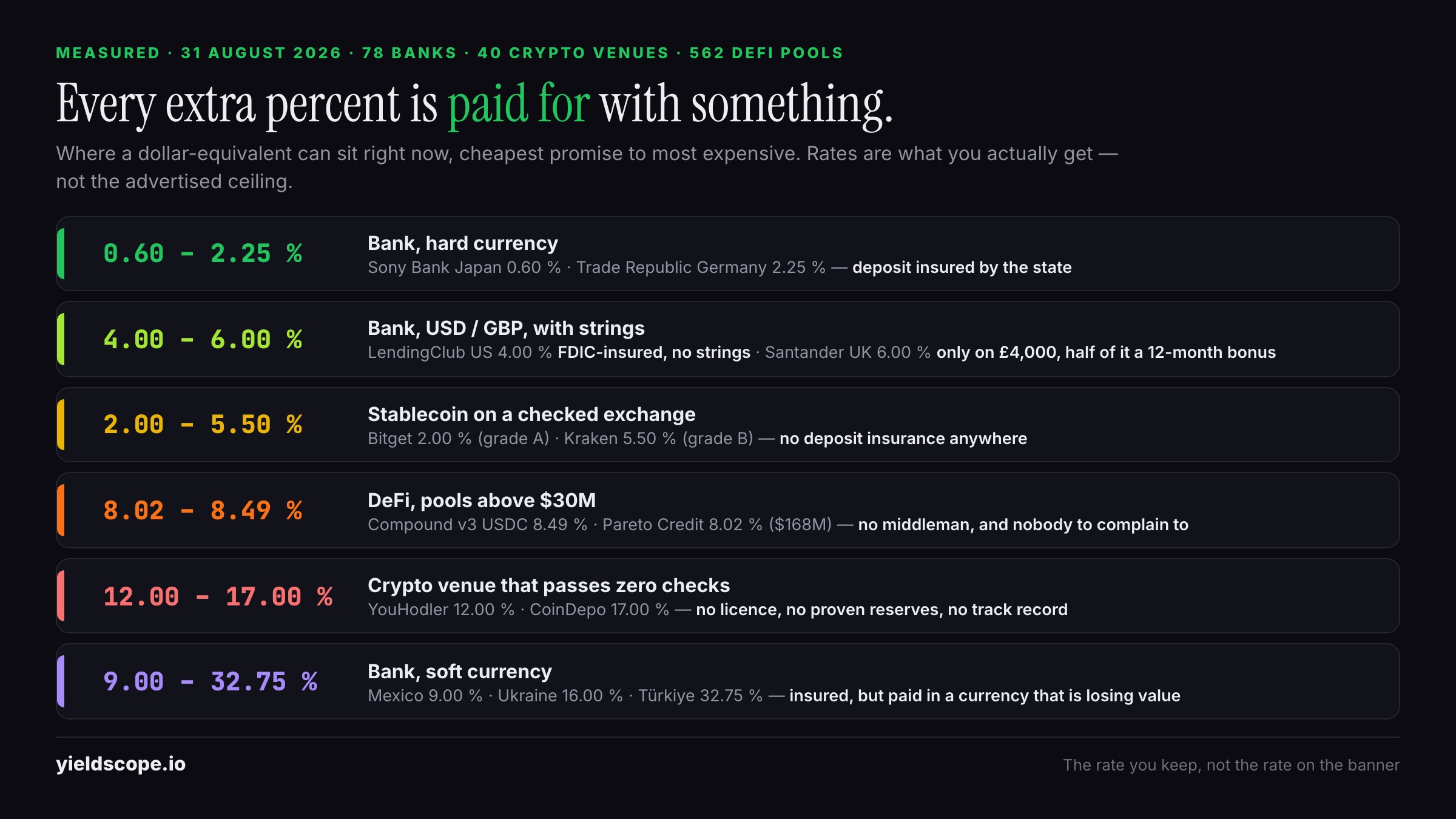
So MetaMask's 4% lands below most of the board. What you are paying for is the package: self-custody, spending card, zero exchange onboarding. That is a real product — but purely on yield, it is not the leader. Browse today's stablecoin rates to see the full field.
The risk nobody prices in: mUSD itself
The quietest risk in the Money Account is the asset you hold. mUSD is weeks old. It has no depeg history because it has no history — that cuts both ways.
Questions we would want answered before parking savings in any new stablecoin:
- What backs it, exactly? Bridge is a serious issuer (Stripe-owned, powers stablecoin infrastructure for many fintechs), but "serious parent company" is not a reserve attestation. Look for regular third-party attestations of mUSD reserves.
- How deep is liquidity? A stablecoin you cannot exit at $1.00 in size, in a hurry, is not a dollar. Early-stage coins have thin order books by definition.
- What happens under stress? Every stablecoin looks fine until the first panic. Our depeg risk guide explains the mechanics that decide whether a coin snaps back or spirals.
None of this says mUSD is unsafe. It says mUSD is unproven — and an unproven peg plus a variable DeFi rate is a different product than "a savings account", whatever the interface looks like.
Who this is actually for
A good fit if: you already live in MetaMask, you want your idle stablecoins working without touching an exchange, you value spending directly from the earning balance, and 4%-ish variable is acceptable for the convenience.
A poor fit if: you are optimizing for the highest safe rate (the board above beats it), you want a proven stablecoin (USDC and USDT have years of redemption history; mUSD has weeks), or you are in an excluded region like the UK.
The bigger picture
The Money Account is the clearest sign yet of where crypto yield is going after GENIUS: yield moves out of issuers and exchanges, into wallets and DeFi rails, with a compliance-friendly wrapper. Coinbase already narrowed its USDC rewards to paid subscribers; MetaMask now ships vault yield natively. Expect every major wallet to follow.
For savers, that is mostly good news — more competition, more transparent on-chain plumbing. It also means the comparison job gets harder: rates will live in more places, with more asterisks. Which is, well, why we track every platform side by side.
Quick answers
Is the MetaMask Money Account safe? It is self-custodial (no exchange can freeze your funds) and built on audited DeFi rails, but you carry three real risks: variable-rate DeFi lending risk, smart-contract risk in the vaults, and — most under-discussed — peg risk on mUSD itself, a stablecoin with only weeks of history.
Is the 4% guaranteed? No. It is a variable rate produced by DeFi lending markets. It can fall (or rise) at any time without notice.
Is mUSD the same as USDC or USDT? No. It is a new stablecoin issued via Bridge (Stripe's stablecoin arm). It has no multi-year redemption record and far thinner liquidity than the majors.
Can I earn more elsewhere? On raw rate, yes — Aave v3 pays ~6.7–7.2% on the same DeFi risk rail, and several graded CeFi venues pay 5.5%+ (see the comparison above, with safety grades attached).
Bottom line
MetaMask's Money Account is a well-built product with an honest architecture: variable DeFi yield, clearly self-custodial, GENIUS-shaped. It is also a 4% variable rate on an unproven stablecoin — below Aave on the same risk rail, below several graded CeFi venues, with a peg that has never been stress-tested.
If the convenience is the point, it earns a place. If the yield is the point, the board still has better offers — with grades attached. Not financial advice.
Educational content, not financial or legal advice. Sources are linked in the text.