Yield
YieldWhere to keep dollars in 2026: 5 options compared, from bank to stablecoins
An honest comparison of 5 ways to park your dollars — cash, HYSA, T-bills, stablecoin Earn, DeFi. Yields, insurance, liquidity, risks for each.

Dollars sitting idle — in a checking account, at a broker, or in cash — quietly lose 2-3% of purchasing power every year to inflation. $10,000 left untouched for five years buys roughly what $8,600-9,000 buys today.
The good news: in 2026 there are several legitimate ways to make dollars work, from fully insured bank products to stablecoin yield. The honest news: each option trades off yield, safety, and accessibility differently, and no single one is "best" for everyone. Here are all five, compared without the sales pitch.
Option 1: cash or a regular checking account — 0%
The baseline. Physical cash and standard checking accounts earn nothing, so inflation erodes them year after year. The one thing they offer is instant liquidity — and that matters. An emergency buffer of 1-2 months of expenses genuinely belongs here, where you can grab it in seconds.
The mistake is keeping years of savings at 0%. That's not safety, that's a slow guaranteed loss. Everything below is about the money beyond your emergency buffer.
Option 2: high-yield savings account (HYSA) — roughly 3.5-4.5%
If you're a US resident (or have access to equivalent EU products), an HYSA is the simplest upgrade available. Online banks pay roughly 3.5-4.5% APY, deposits are FDIC-insured up to $250,000 per bank, and withdrawals take a day or two. There is no catch beyond the rate moving with the Fed.
For risk-free dollar yield, this is the benchmark every other option should be measured against. If you qualify and you're not earning at least this on idle cash, fix that first — before considering anything with real risk.
The limitation is access: HYSAs require US (or EU, for equivalents) residency, a tax ID, and a local address. For a large part of the world holding dollars, this door is closed.
Option 3: short-term US Treasury bills — roughly 3.5-4.5%
T-bills are debt of the US government maturing in 1-12 months. They're considered about the safest dollar asset that exists: backed by the full faith and credit of the United States, yielding in the same 3.5-4.5% range as HYSAs, sometimes slightly more. Interest is also exempt from US state income tax.
What you need: a brokerage account (Treasury Direct for US persons, or brokers like Interactive Brokers internationally) and a little patience with the buying mechanics — auctions, maturities, rolling positions, or simply a T-bill ETF. Liquidity is good but not instant: selling before maturity takes days and can cost a few basis points.
T-bills make the most sense for larger amounts ($10k+) where the operational overhead is worth it, and for people who already have a brokerage relationship. For non-residents, opening and maintaining that brokerage account is the real hurdle — compliance checks, country restrictions, and paperwork.
Option 4: stablecoins on an exchange (Earn) — roughly 4.5-16%
Stablecoins (USDT, USDC) are tokens pegged 1:1 to the dollar. Crypto exchanges pay yield for depositing them into Earn programs: flexible rates typically run 4.5-7%, while promotional and locked products reach 10-16%.
Why this option exists on the list at all: it's the only dollar-yield instrument that doesn't care where you live. No US residency, no SSN, no brokerage compliance — an account takes an evening to set up, the entry threshold is $10-100, and withdrawals usually clear within hours. For people outside the US/EU banking system, this is often the only practical way to earn on dollars.
Now the honest part: there is no insurance. An exchange is not a bank. If the platform fails — FTX in 2022 is the canonical example — no government makes you whole. Counterparty risk is the defining risk of this option. You reduce it (not eliminate it) by choosing exchanges with Proof-of-Reserves, real licenses, and insurance funds, and by splitting funds across 2-3 platforms. There's also depeg risk in the stablecoin itself: USDC briefly traded at $0.87 in 2023 before recovering; USDT has dipped to $0.95.
A fair framing: stablecoin Earn pays roughly 1-10 percentage points more than an HYSA, and that premium is exactly the price of carrying platform risk without a safety net. Whether that trade is worth it is a personal decision, not a universal truth.
If you want to see what exchanges actually pay right now, that's what we built the live rate table for. New to this entirely? Start with the beginner's guide to stablecoin yield and the bank deposit vs stablecoin comparison.
Option 5: DeFi stablecoin pools — roughly 5-20%+
One level deeper: instead of lending to an exchange, you deposit stablecoins directly into on-chain protocols — lending markets like Aave and Morpho, or stable-stable pools on Curve. Rates are often higher than CeFi, and your funds stay in your own wallet, which removes exchange counterparty risk entirely.
What you get in exchange is a different risk stack: smart-contract risk (protocols do get exploited), user-error risk (phishing sites, wrong networks, lost seed phrases), and meaningful technical complexity — wallets, gas fees, network selection. Yields are also more volatile, since they're set by supply and demand rather than a marketing department.
DeFi is the right tool for people who are already comfortable with exchange-based yield and want more control or higher rates. It is the wrong place to start. We cover how it works in the DeFi yield guide.
The comparison table
| Option | Yield | Insurance | Liquidity | Entry barrier | Main risk |
|---|---|---|---|---|---|
| Cash / checking | 0% | — | instant | none | inflation |
| HYSA | 3.5-4.5% | FDIC $250k | 1-2 days | US/EU residency | access only |
| T-bills | 3.5-4.5% | US government | days | brokerage account | access, ops overhead |
| Stablecoin Earn | 4.5-16% | none | hours | $10-100 | platform failure, depeg |
| DeFi pools | 5-20%+ | none | minutes-hours | $100+ and skills | smart-contract exploits |
How to choose for your profile
"I want zero risk." If you have access to an HYSA or T-bills, use them and skip crypto entirely — 4% with insurance beats 8% without it when peace of mind is the goal. There is no shame in this answer, and any honest crypto site should say so. If you don't have access to insured products, keep your buffer in cash and only test stablecoins with a small amount.
"I'll take moderate risk for 5-10%." The typical profile: pick 2-3 vetted exchanges, use flexible Earn rates, split between USDT and USDC, and never deposit more than you could afford to lose entirely. Start by comparing current rates rather than trusting whichever exchange advertises loudest.
"Experienced, want maximum yield." A combination: a CeFi base on exchanges plus a portion in battle-tested DeFi protocols with multi-year track records. Chasing 20%+ in protocols launched last month isn't saving anymore — it's speculation, and it should be sized like speculation.
The mistakes that actually cost money
- Putting everything on one exchange. Platform diversification is rule number one of uninsured yield. The FTX lesson was expensive enough — no need to repeat it personally.
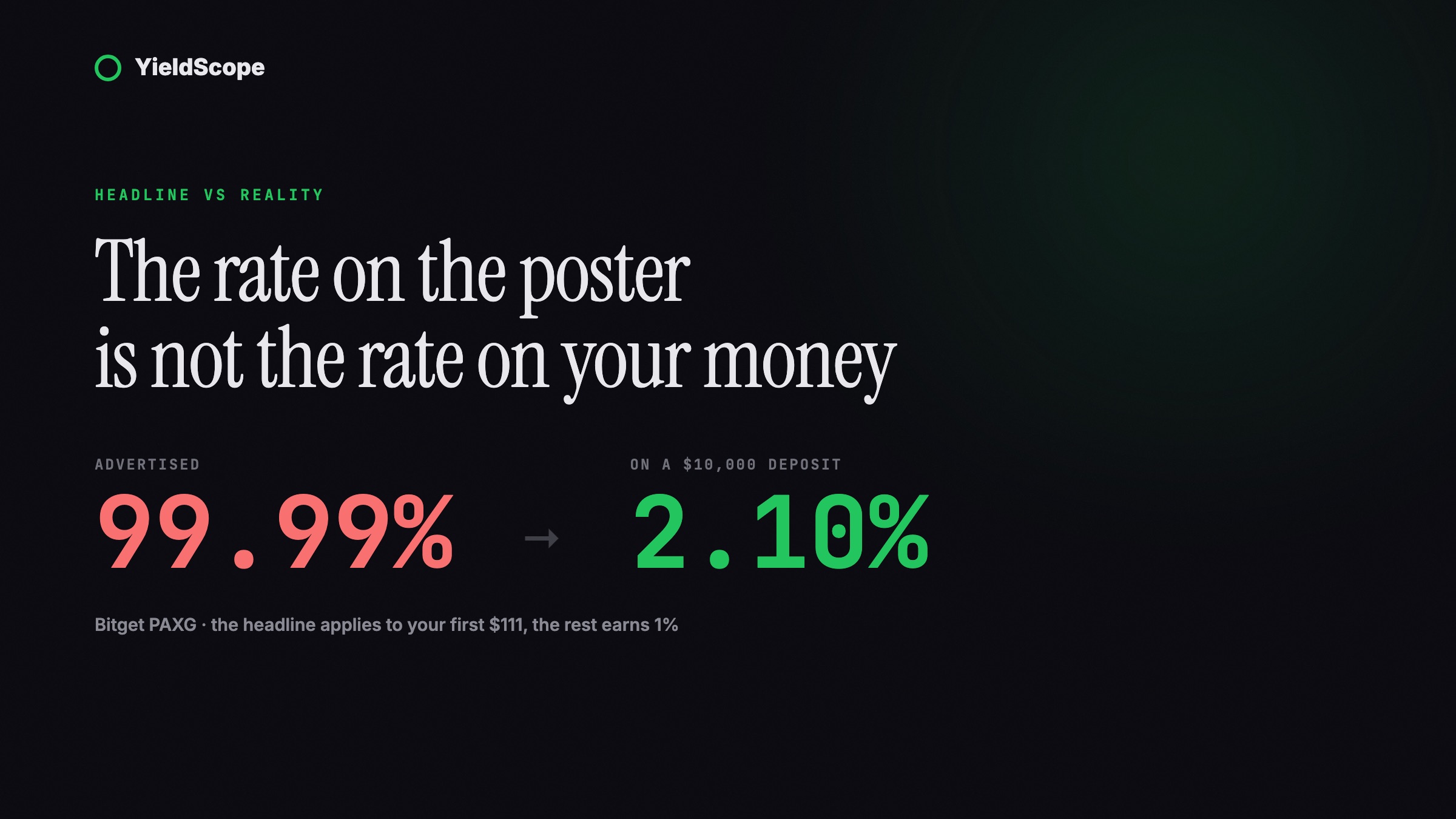
- Picking by the biggest APY number. A 16% headline usually hides a $200-500 cap, a 90-day lock, or a temporary promo. Read the terms; effective yield on real money is what matters.
- Treating stablecoin yield like a bank deposit. It looks similar on the surface. It isn't. The extra yield exists because there's no insurance — internalize that before depositing.
- Starting with DeFi. One signature on a phishing site can drain a wallet. Earn the experience on exchanges first.
- Ignoring insured options you actually qualify for. If an HYSA is available to you, 0% in checking is simply leaving free, insured money on the table.
FAQ
Is stablecoin yield safe?
Safer than volatile crypto, riskier than a bank. The two real risks are platform failure and stablecoin depeg. Both are reduced — not eliminated — by diversifying across platforms and sticking to stablecoins with transparent, audited reserves.
What's the realistic rate, without the marketing?
Flexible Earn on major exchanges pays roughly 4.5-7% on USDT/USDC. The 10-16% figures are mostly capped promos or locked terms. Check live rates rather than screenshots from ads.
How much money do I need to start?
$10-100 is enough. The sensible path: deposit a small test amount, run the full cycle — deposit, Earn, withdraw — and only then commit meaningful money.
Why not just buy T-bills instead?
If you have easy brokerage access, T-bills are an excellent insured-equivalent choice and we genuinely recommend considering them. Stablecoins win on three things: accessibility from anywhere, higher potential yield, and $10 entry. They lose on safety. Many people reasonably use both — insured products for the core, stablecoins for the part of the portfolio where they accept platform risk in exchange for extra yield.
Where do I track which option pays best right now?
Bank and Treasury rates move slowly; stablecoin rates change weekly. YieldScope tracks Earn rates across major exchanges daily, so you can see in ten seconds where a given amount earns the most today — and whether the premium over an insured 4% is still worth the risk for you.
This is not financial advice. Yields are not guaranteed, rates change constantly, and past performance doesn't predict future results. Crypto assets are not covered by government deposit insurance — never deposit more than you can afford to lose.
Educational content, not financial or legal advice. Sources are linked in the text.