Yield
YieldMiCA is live: the EU just redrew the crypto safety map — and the viral lists are wrong
From July 1, 2026, no EU license means no EU. Here's who actually made it, what the viral screenshots get wrong, and why it's really about the safety of your funds.

If you hold crypto in Europe, today matters. As of July 1, 2026, the transitional period for MiCA — the EU's Markets in Crypto-Assets regulation — is over. The grace window that let exchanges keep operating under old national registrations has closed, with no extension. The rule is now blunt: hold a MiCA license from an EU regulator, or stop serving EU users.
Screenshots of "green list vs red list" are flying around Telegram. Most get the gist right and the details wrong. Since regulation is one of the five checks behind every safety grade we publish, we verified the map against primary sources (ESMA's register, national regulators, exchange statements). Here's the honest version.
Who is licensed and staying
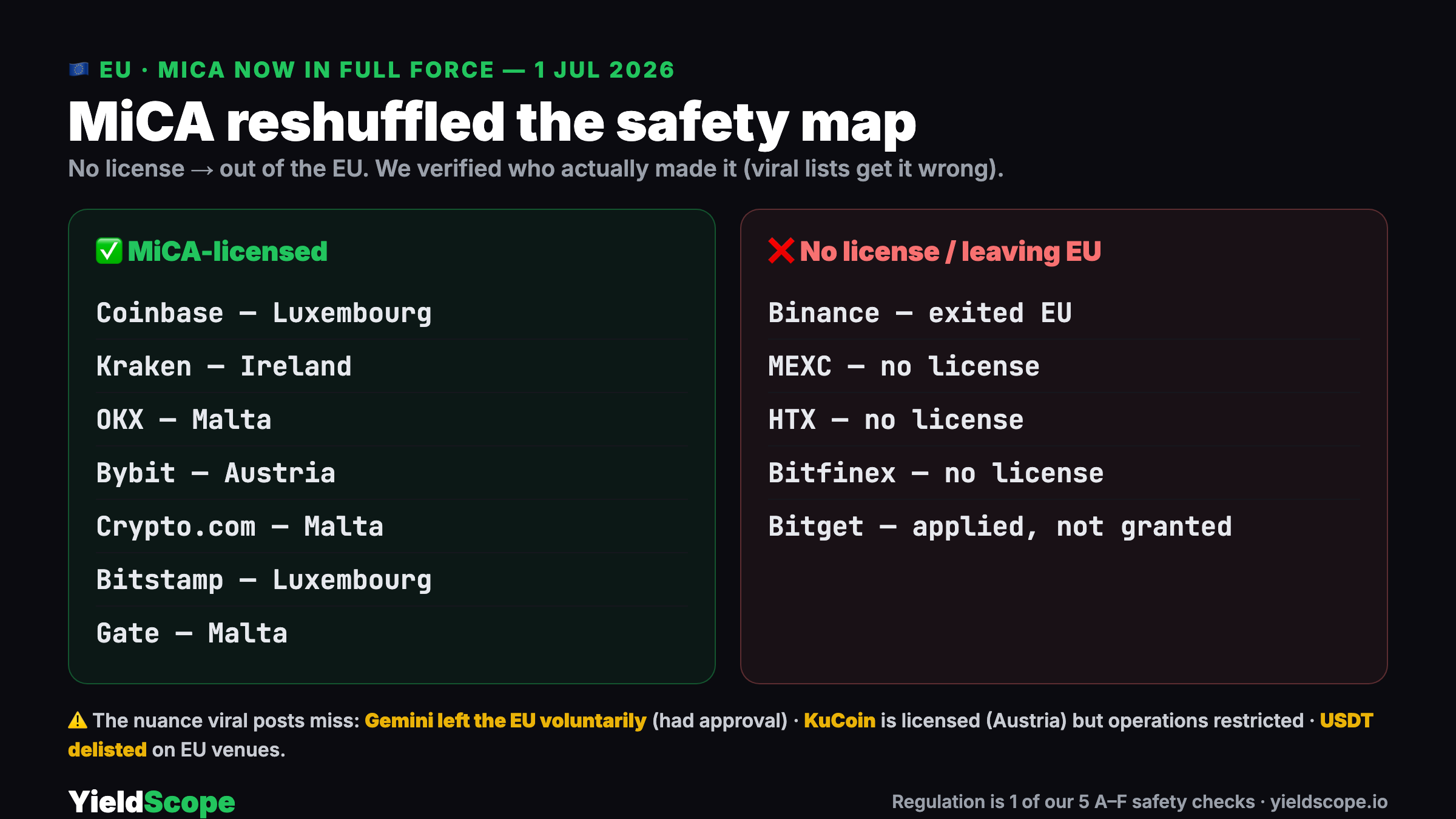
Confirmed MiCA-licensed, with the member state that issued the license:
- Coinbase — Luxembourg
- Kraken — Ireland
- OKX — Malta
- Bybit — Austria
- Crypto.com — Malta
- Bitstamp — Luxembourg
- Bitvavo — Netherlands
- Bitpanda — Austria
- Gate — Malta
A MiCA license "passports" across all 27 EU states, so one approval means EU-wide access.
Who is out or leaving
- Binance — withdrew its EU application and halted EU services around the deadline. It says it may re-apply in France later.
- MEXC — no license; told EU users to withdraw funds before July 1.
- HTX and Bitfinex — no license, no public EU plan.
- Bitget — applied in Austria but was not granted a license by the deadline.
What the viral lists get wrong
This is where a quick screenshot misleads you:
- Gemini is shown as "approved." In reality Gemini left the EU/EEA voluntarily in April 2026 and closed EU accounts — a business decision, not a regulatory rejection. It had authorization; it chose to exit.
- KuCoin is shown as simply "barred." It actually holds an Austrian license (November 2025), but a separate regulator decision restricts it from commencing operations. Licensed but limited — not the same as "no license."
- Bitget is shown as flatly rejected. More precisely: it applied and wasn't granted in time.
Small distinctions, but they change what you should do with your account. That is the whole point of checking sources instead of resharing an image.
The "80% will fail" number
You will see claims that up to 80% of exchanges won't survive MiCA. That figure traces back to the CEO of a competing licensed exchange, not an independent study. The verifiable data is still striking: of 1,200+ registered crypto firms, only around 210 became licensed CASPs — roughly a 17% conversion. So the direction is real (most did not make it), but treat "80% will vanish" as a talking point, not a statistic.
Why this is really a safety story
Strip away the drama and MiCA is about custody and accountability. Licensed providers must segregate client assets from company assets, publish disclosures, and answer to a regulator. In plain terms: if a licensed exchange fails, client crypto is meant to be shielded from its creditors — the exact protection missing at Mt. Gox and FTX.
That is why, on YieldScope, regulation is one of five checks — alongside proof of reserves, flexible withdrawals, an insurance fund, and track record — that decide an exchange's A–F grade. See how we build the data on our transparency page. MiCA doesn't make a licensed venue risk-free, but it moves the regulation check firmly into the "pass" column — which matters when you're deciding where to park money for yield.
The bull and bear view
Bull: cleaner rules, segregated funds, one license for all of Europe, and fewer fly-by-night venues. Safer defaults for ordinary users.
Bear: EU users lose access to some of the deepest, cheapest venues (Binance, MEXC). USDT — the largest stablecoin — has been delisted on EU exchanges because Tether doesn't meet MiCA's issuer rules, fragmenting liquidity. Compliance costs push smaller players offshore. Less choice, potentially wider spreads.
What to do if you're in the EU
- If your exchange is on the licensed list, you likely don't need to act — but verify your country's status in-app.
- If it's on the out list, don't panic-sell; move funds to a licensed venue in an orderly way before access is cut.
- Don't assume a green checkmark in a screenshot is current. Check the exchange's own EU status page.
MiCA didn't end crypto in Europe. It sorted it. The venues that stayed are, by definition, the ones that accepted oversight — and for a saver choosing where to earn yield, that oversight is a feature, not a footnote. Compare current rates and safety grades on our weekly board.
Not financial advice. Verify your exchange's current EU status before moving funds.
Educational content, not financial or legal advice. Sources are linked in the text.