Yield
YieldYieldScope Rate Report #1: F-Graded Platforms Pay 6.7× the Median Stablecoin Rate of A-Graded Ones — and Why That's a Warning
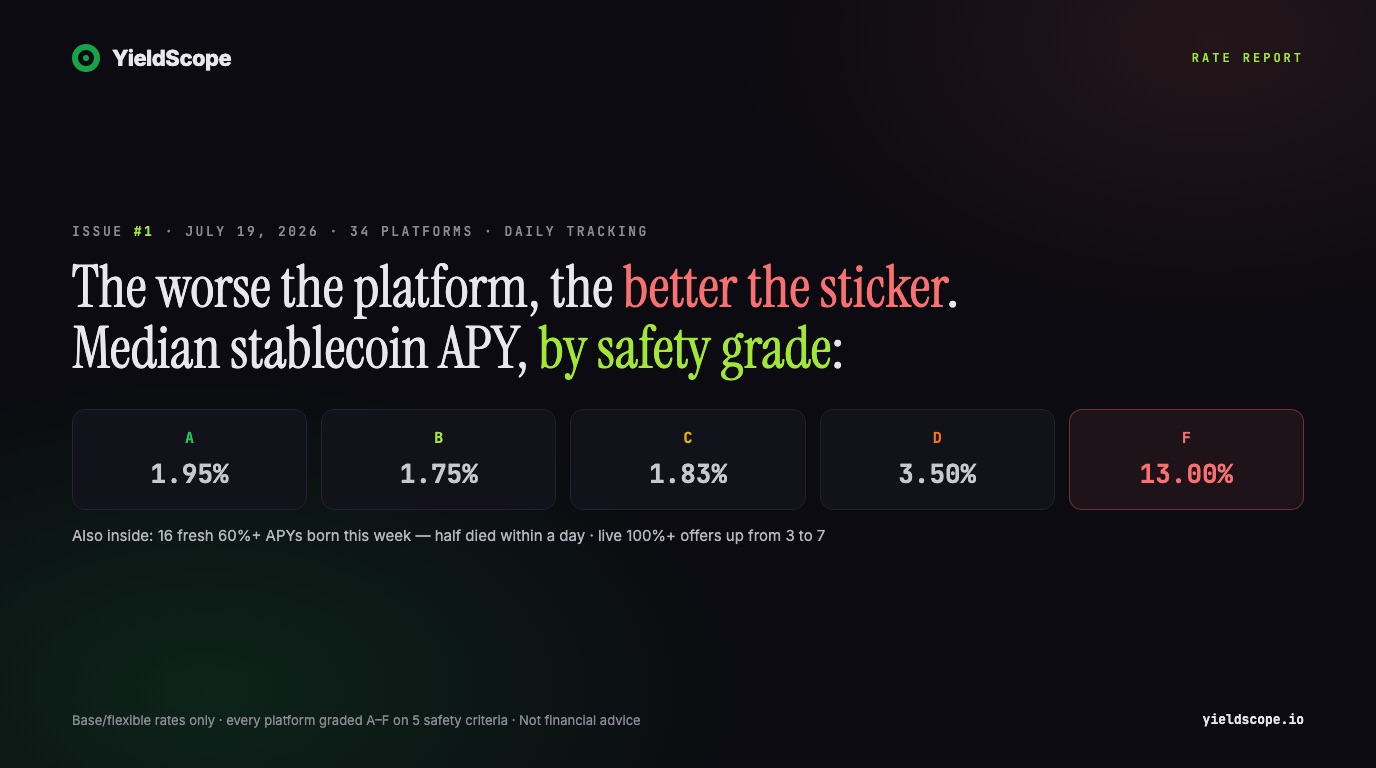
First issue of our recurring crypto-rate report: median stablecoin APY is 13% on F-graded platforms vs 1.95% on A-graded; half of the 16 fresh 60%+ rates died within a day (DATA on Bitget did it three times in one week); live 100%+ APYs grew from 3 to 7. All numbers from our daily tracking of 34 platforms.
We track flexible earn rates across 34 crypto platforms every day, grade each platform A to F on five safety criteria, and keep the full daily history. This is the first issue of the YieldScope Rate Report — a twice-weekly, data-first look at what crypto yield actually did, built entirely from our own tracking. Every number below comes from our public dataset and can be verified on the site.
The week of July 12–19 gave us three stories: a paradox in stablecoin pricing, an exchange printing triple-digit APYs faster than they can die, and a quiet group of rates that never moved at all.
The grade paradox: the worse the platform, the better the sticker
We grade every platform from A to F: five verifiable safety criteria (regulation, proof of reserves, withdrawal freedom, insurance, track record), one point each. Then we lined up every stablecoin rate we track against the grade of the platform paying it.
The result is the cleanest risk lesson we have published to date:
| Platform grade | Stablecoin rates tracked | Median APY | Top rate |
|---|---|---|---|
| A | 6 | 1.95% | 5.00% |
| B | 17 | 1.75% | 7.08% |
| C | 12 | 1.83% | 5.50% |
| D | 9 | 3.50% | 9.74% |
| F | 6 | 13.00% | 17.00% |
The median stablecoin rate on an F-graded platform is 13% — six to seven times higher than on A- and B-graded platforms. That is not because weak platforms found a magic yield source. It is the price of risk, printed on the label: the harder it is for a platform to pass basic safety checks, the more it has to pay to attract deposits.
The flip side matters just as much: safety does not mean zero yield. The best A/B-graded stablecoin rates right now are 7.08% on USDS at WhiteBit (grade B), 5.5% on USDT at Kraken (grade B) and 5.0% on USDS at Bitget (grade A). A saver gives up surprisingly little headline yield to move from an F platform to a graded one — and gives up all of the "17% forever" illusion, because that number rarely survives contact with reality anyway.
The yield printer: 16 born, 8 dead by morning
The second story is speed. During July 12–18 we counted 16 flexible-earn rates that jumped from under 30% to over 60% APY — what we call a "fresh high rate". Exactly half of them, 8 of 16, collapsed by more than 50% within one day of appearing.
Our longer-run tracking says this week was actually mild: across our full history, roughly 7 in 10 fresh 60%+ rates fail to survive their first day. Either way, the conclusion is the same — a triple-digit APY is not income. It is a countdown that usually ends before your deposit settles.
One coin made the point three times in a single week. DATA on Bitget spiked to 131% on July 13 and paid 2.4% the next day. It spiked again to 98% on July 15 — 8.6% the day after. On July 17 it hit 275%; within 24 hours it was at 54%, and it kept sliding to 25% two days later. Anyone who moved money chasing any of those three peaks arrived, on average, after the rate was already gone.
Meanwhile the printer sped up. On July 12 we tracked 3 live rates above 100% APY. Today there are 7, and the top of the board looks like a slot machine: T at 365%, GWEI at 365% (its tenth straight day at that number — a rare long-lived outlier), RE at 220%, NEO at 192%, GENIUS at 160%. Six of the seven sit on a single exchange, Bitget, which has clearly made rotating headline APYs part of its acquisition playbook. The rates are real while they last — our tracking simply shows they usually do not last a day.
What actually paid: the boring champions
The third story is the one nobody screenshots. While 16 rockets launched and 8 exploded, these rates did not move at all:
- USDD on Gate (grade B) — 5.09%, unchanged for 27 straight days
- USDT on Kraken (grade B) — 5.5%, unchanged for 26 straight days
- USDS on WhiteBit (grade B) — 7.08%, unchanged for 22 straight days
- USDS on Bitget (grade A) — 5.0%, unchanged for 11 straight days
Over those 26 days, the Kraken rate generated exactly what it promised, every day, with no timing skill required. That is the entire trade-off in one sentence: the highest rates pay you for arriving early to a party that is already ending, while graded, boring rates pay you for showing up at all.
Note, 23 September 2026: the 5.5% for USDT at Kraken was entered in June and not re-checked after: our collector could not see Kraken's Opt-In Rewards. Kraken's own support page (17 Sep 2026) gives its flexible rate on USDT as 4.00%, with 5.60% only on an 18-month fixed term, and the product is not offered in the US or the EEA. Its 26-day streak is that figure carried forward, not an observed stable rate.
What to do with this if you hold stablecoins
This report is descriptive, not advice — but the data suggests three practical habits.
First, read the grade before the rate. The single strongest pattern in our dataset is that headline APY is inversely correlated with platform safety. A 17% stablecoin rate is not a better deal than a 5.5% one; it is a different product with a different risk attached. If you would not lend money to an unregulated company with unaudited reserves for 17% a year, the coin wrapper should not change your answer.
Second, treat any rate above roughly 60% as an event, not an offer. By the time a screenshot of it reaches you on X or Telegram, the odds it still pays that number are, per our tracking, roughly a coin flip within the first day and worse after. Fresh triple-digit rates are marketing spend by exchanges — real while budgeted, gone when the budget moves to the next ticker.
Third, if you value predictability, the streak is a more useful number than the APY. A rate that has held for 20+ days on an A/B-graded platform has demonstrated something a 300% rate never can: that it will probably still be there tomorrow. Our stablecoins board shows current rates with grades side by side, and every platform page lists which safety checks it passed and which it failed — for example Kraken's breakdown.
Numbers ready to cite
For editors and researchers, this issue in three quotable lines:
- The median stablecoin APY on F-graded crypto platforms is 13% — about 6.7× the 1.95% median on A-graded platforms (YieldScope, July 19, 2026).
- Half of the fresh 60%+ APYs that appeared during July 12–18 collapsed within one day; long-run, about 7 in 10 die that fast (YieldScope tracking, 34 platforms).
- Live 100%+ APY offers more than doubled in a week — from 3 to 7 — with 6 of 7 concentrated on one exchange (YieldScope, July 19, 2026).
Methodology
We poll public earn/staking endpoints and official pages of 34 CeFi platforms daily and store every rate with its date in an open history. Rates shown are base/flexible tiers — no promo, lock-up or token-boosted tiers. Platform grades are pass-counts over five published safety criteria; the full breakdown for every platform is public on its page. A "fresh high rate" is a move from below 30% to above 60% APY between two consecutive daily snapshots; "died within a day" means the next snapshot is more than 50% below the peak. Current rates for every platform and coin, with grades: our stablecoins board. How the grading works: transparency page.
Journalists: we can pull custom cuts of this dataset (per-exchange, per-coin, longer windows) on request — hello@yieldscope.io. Reuse any number with attribution to YieldScope.io.
Not financial advice. Rates are snapshots and change daily.
Educational content, not financial or legal advice. Sources are linked in the text.