Yield
YieldBitMart Is Closing: What Happens to Your Coins, Earn Balances and Withdrawals
BitMart is winding down: trading stopped on August 26, 2026, and the platform shuts on January 31, 2027. What the exchange itself says about withdrawals and Earn products, where its $319.5 million hole comes from, and the three repayment options it proposes — from its own documents.
BitMart is closing. Trading stopped on August 26, 2026, and the platform is set to shut on January 31, 2027. If you still have coins or Earn balances there, this is what BitMart's own documents say, as of October 15, 2026. We did not list BitMart on our board, so this is not about its rates; it is about getting money out.
The short answer
- BitMart says withdrawals remain open, but every request can go through manual review, and BitMart warns that processing may take longer.
- Earn, Staking and Lending are being closed in phases. BitMart says redemption terms come in separate notices and asks users to redeem eligible products themselves.
- BitMart says a hack in December 2021 left it short by about $319.5 million. It proposes a court-sanctioned plan in which every balance is converted to dollars and each user picks one of three ways to be repaid.
- The plan is not final. BitMart is collecting feedback in October 2026 and aims to apply to court in December 2026 or January 2027.
The timeline
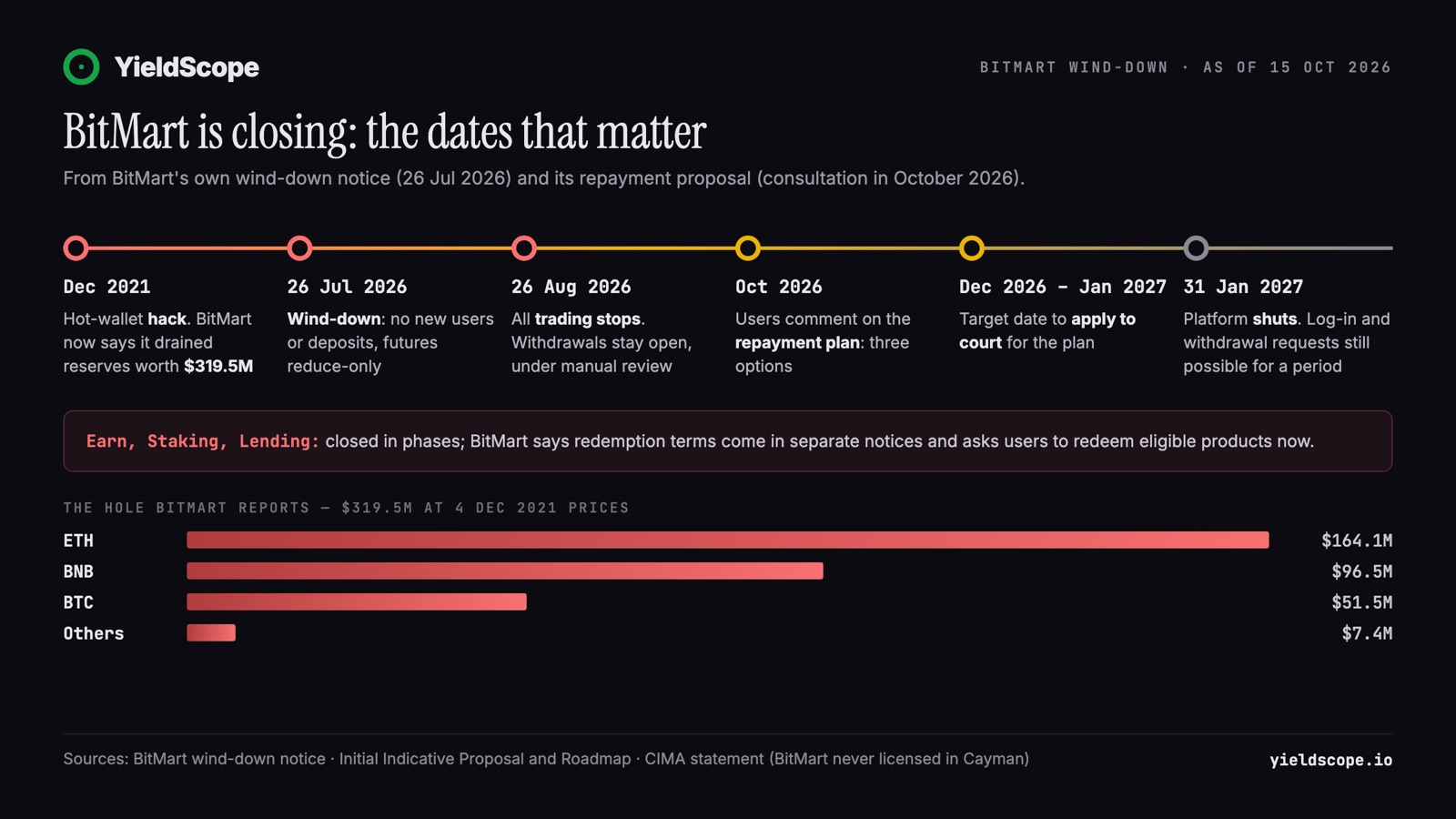
BitMart announced an "orderly wind-down of its trading platform operations" on July 26, 2026. In its own words:
- July 26, 2026 — it started to stop new registrations and deposits; futures went to reduce-only mode and spot stopped taking new orders
- August 26, 2026 — "BitMart will discontinue all spot, futures, and other trading services"; open futures positions may be settled by the platform
- January 31, 2027, 15:59 UTC — BitMart "plans to officially cease trading platform operations"
Closing the platform does not lock you out on that date. BitMart says that after operations cease, users "will still be able to log in for a specified period to access their accounts, review historical records, and submit withdrawal requests."
Withdrawals: open, but slow
The notice says "the withdrawal service will remain available." It recommended submitting withdrawal requests before 05:00 UTC on August 26, 2026, and warned that requests may be reviewed: identity and KYC checks, login devices and IP addresses, withdrawal addresses, the source of funds, Travel Rule and sanctions screening. BitMart adds that "submitting a withdrawal request does not mean that the review has been completed or that the assets have been broadcast to the blockchain."
Requests filed after the recommended window are moved to "a dedicated processing procedure", with details promised in separate announcements.
Earn, Staking and Lending
The notice treats these together: "BitMart Earn, Staking, Lending, Launchpad, and other products will be discontinued in phases according to their respective product arrangements." Redemption and settlement procedures will be sent "through dedicated announcements and in-platform notifications." Among the actions BitMart asks of users is to "redeem any eligible Earn, staking, lending, or other investment products."
We found nothing in BitMart's repayment proposal that treats Earn balances differently from any other balance. Under the plan every account balance is converted into a dollar amount.
Where the $319.5 million hole comes from
In its "Initial Indicative Proposal and Roadmap", BitMart writes that the December 2021 hack "depleted BitMart's digital asset reserves (approximately US$319.5 million (dollarized as of 4 December 2021))". It breaks the loss down by chain:
| Asset | Value at 4 Dec 2021 prices |
|---|---|
| Ethereum | $164.1M |
| BNB | $96.5M |
| Bitcoin | $51.5M |
| Others | $7.4M |
| Total | $319.5M |
BitMart says profits from the bull market let it keep serving users for a long time after the hack. In 2026, it says, the business became loss-making. The company says it considered an investor's public offer to inject $10 million and judged it "manifestly insufficient."
The three repayment options
Each balance would be converted into dollars using the weighted average trading price of each token from July 26, 2026 to a record time still to be set. Each user would then choose:
- Option 1, upfront distribution — a pro-rata payout now, from BitMart's currently available liquid assets: fiat, stablecoins such as USDC, PYUSD and USDT, and BTC, ETH and SOL
- Option 2, Restitution Token — one token per dollar of balance, backed by whatever BitMart recovers of the 2021 hack proceeds
- Option 3, Continuum Token — backed by BitMart's investments, sales of its illiquid assets and, only if the business restarts, future profits
BitMart says it is preparing a report with the estimated return of each option in percentage terms. Until it is published, nobody outside BitMart can say how much of a balance Option 1 returns.
The plan's timetable, from BitMart: consultation through a feedback portal in October 2026, adjustments in November, and an application to "the relevant courts" in December 2026 or January 2027, after which a court-appointed officer would adjudicate the dollar balances.
Who regulated it
No one in the Cayman Islands, at least. On August 6, 2026, the Cayman Islands Monetary Authority said that BitMart and its related entities "are not, and have never been, registered, licensed, regulated, or otherwise authorised by the Authority to conduct virtual asset service provider business in or from within the Cayman Islands."
If you still have money on BitMart
From BitMart's own list:
- Log in only through the official website or app and check your balances
- Complete or update identity verification; BitMart's reviews include identity checks
- Redeem any Earn, staking or lending product that can be redeemed
- Check the network and address twice before you submit a withdrawal, and do not submit duplicates
- Download your balances, deposit, withdrawal and trade history now, while you can; you will need them for any claim and for taxes
- Ignore anyone who asks for an "expedited processing fee", an "unfreezing fee" or a "security deposit": BitMart says it charges none and never asks for passwords, codes or recovery phrases
What this says about choosing a venue
An exchange can keep operating for years on top of a hole it has not closed. That is why our grades look at proof of reserves and insurance funds and at the track record over the last two years, not only at the rate. A grade is not a guarantee, but it shows you which venues publish the numbers that would let you see a hole like this one. The venues that pass the most checks are on our safest venues page.
We will update this page when BitMart publishes the estimated returns for each option or files with a court. This is not financial or legal advice.
Educational content, not financial or legal advice. Sources are linked in the text.