Yield
YieldCrypto loans explained — how to borrow against your coins
How crypto-backed loans work, CeFi vs DeFi, what rates to expect, and the one risk that matters most — liquidation. In plain words, with live rates.

Most people in crypto eventually hit the same wall: you believe in your coins long-term, but you need cash now. Selling means giving up your position — and often triggering a taxable event. Crypto loans offer a third way: borrow against your crypto without selling it.
This guide explains how crypto-backed borrowing actually works, the difference between CeFi and DeFi loans, what rates to expect, and the one risk that decides whether it ends well — liquidation.
What a crypto loan is
A crypto loan is secured debt. You lock up crypto you already own (the collateral) and borrow another asset against it — almost always a stablecoin like USDC or USDT, sometimes fiat. You keep ownership and upside of your collateral; you just can't move it until you repay.
The mechanics are the same almost everywhere:
- Deposit collateral — say 1 BTC.
- Borrow up to a limit set by the loan-to-value ratio.
- Use the money — spend it, trade it, or earn yield elsewhere.
- Repay principal plus interest, on your own schedule (open-ended) or by a deadline (fixed-term).
- Get your collateral back once the loan is closed.
If your collateral falls too far in value, the platform sells part of it automatically to keep the loan covered. That is a liquidation, and it is the thing that catches people out.
Loan-to-value (LTV): the number that runs everything
LTV is your loan amount divided by collateral value. Borrow $30,000 against $100,000 of BTC and your LTV is 30%.
- Lower LTV is safer. Your collateral can drop a long way before you are at risk, and the rate is often lower.
- Higher LTV gives more cash now, but a smaller price drop can trigger a margin call or liquidation.
Every platform sets a maximum LTV (commonly 50% for BTC and ETH), a margin-call level, and a liquidation level. Borrowing right up to the max is tempting and cheap — and it is exactly how people lose collateral in an ordinary 20–30% market dip.
A worked example
You deposit 1 BTC worth $100,000 and borrow $50,000 (50% LTV). The platform liquidates at, say, 80% LTV. If BTC falls to $62,500, your $50,000 loan is now 80% of your collateral — and part of your BTC gets sold to repay the lender, often with a liquidation penalty on top. Had you borrowed only $25,000 (25% LTV), BTC would need to halve to $31,250 before you were in the same danger. Same collateral, completely different survival odds — that is the whole game.
Open-ended vs fixed-term
Open-ended (flexible) loans have no end date. Interest accrues (often hourly or daily) and you repay whenever you want. Most exchange and DeFi borrowing works this way.
Fixed-term loans run for a set period — 30, 90, or 365 days — usually at a fixed rate. Ledn's Bitcoin-backed loan, for example, is a 12-month renewable term. Fixed terms make budgeting predictable; flexible loans make exiting easy.
CeFi vs DeFi loans
There are two worlds, and they trade convenience against trust. For the bigger picture, see CeFi vs DeFi.
CeFi loans are run by a company — Nexo, Ledn, or an exchange like Bybit or Crypto.com. You pass KYC, hand over your collateral, and they custody it.
- Pros: simple, app-based, fiat on-ramps, human support.
- Cons: you trust the firm to hold your collateral and stay solvent — the same counterparty risk that sank Celsius and BlockFi in 2022.
DeFi loans run on smart contracts — Aave, Compound, Morpho. No company holds your coins; code does.
- Pros: non-custodial, transparent, permissionless, rates set live by supply and demand.
- Cons: you manage your own wallet, gas, and smart-contract risk; a bug or oracle failure is on you.
What rates to expect
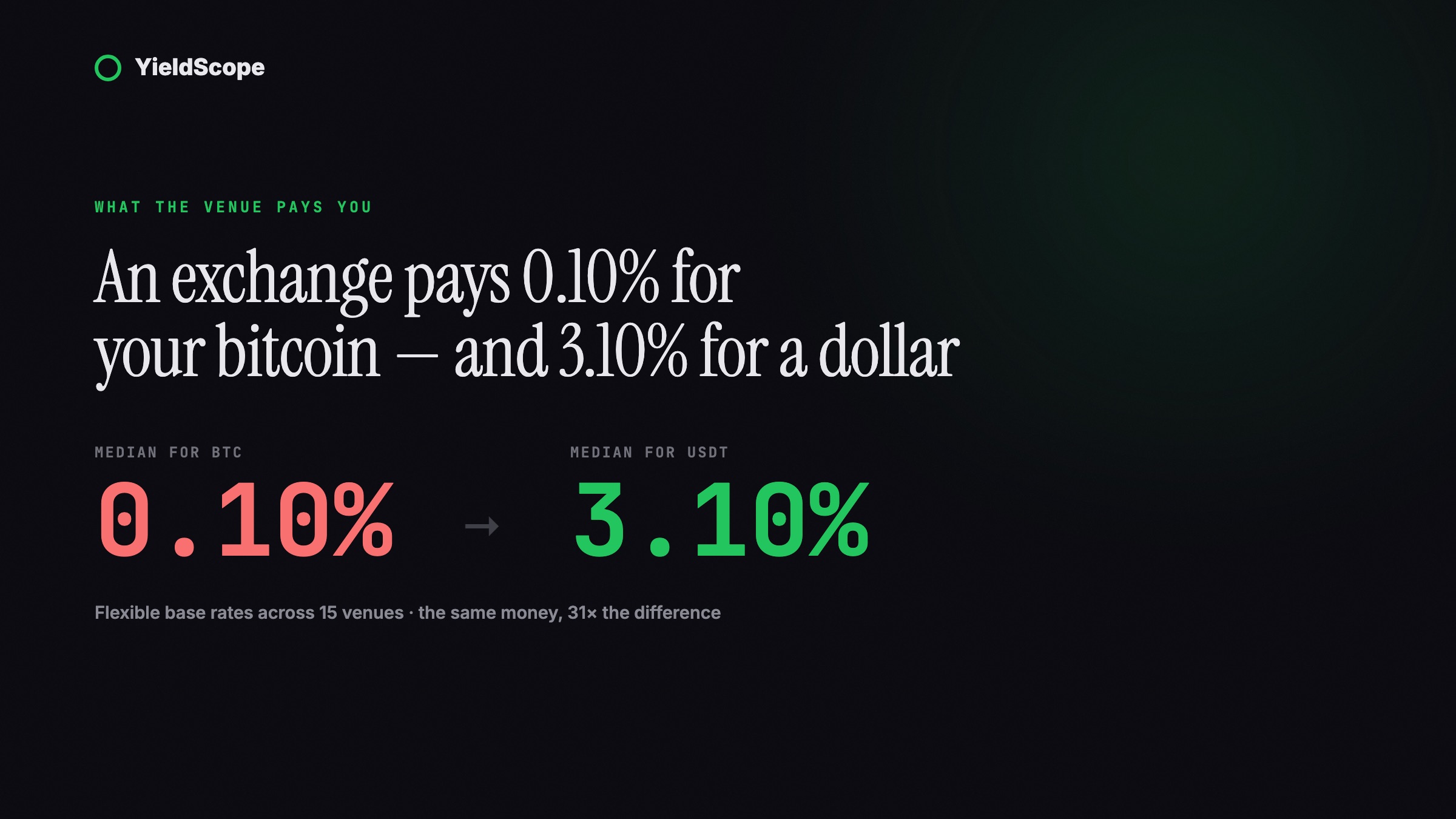
Borrow rates are always higher than earn rates for the same asset — that spread is how lenders and platforms make money. They are also variable: they move with demand, so treat any figure as a snapshot, not a promise.
As a rough 2026 map:
- DeFi stablecoin borrow (Aave, Compound, Morpho): often the cheapest — low to mid single digits.
- Exchange / margin borrow (Bybit, Gate, Bitfinex): variable, from ~1% on quiet days to double digits when demand spikes.
- CeFi consumer loans (Nexo, Ledn, Crypto.com): higher and steadier, often ~8–20% depending on LTV and loyalty tiers.
Beyond interest, watch for fees: some lenders add an origination or admin fee, and a liquidation penalty is charged on top of selling your collateral if you get liquidated.
We track these side by side, updated live where a public source exists, on the crypto borrow rates page. Always check the live number before you commit — a rate you saw last week may be gone.
When borrowing makes sense — and when it doesn't
It can make sense when:
- You want liquidity but do not want to sell (and trigger taxes or lose upside).
- You borrow at a low LTV you can comfortably top up.
- The cost of the loan is lower than what the cash earns or saves you elsewhere.
Be very careful when:
- You borrow near the maximum LTV — a routine dip can liquidate you.
- You use the loan to buy more of the same collateral (leverage on leverage).
- You cannot repay or add collateral quickly if the market moves against you.
A crypto loan is not free money — it is a leveraged position with a liquidation trigger. The honest framing: you are betting your collateral holds or rises faster than interest eats your equity.
How to start safely
- Pick the platform on safety first. For CeFi, check our A–F risk grades and read the review before you deposit. For DeFi, stick to large, audited, time-tested protocols.
- Keep LTV low. Starting around 20–25% gives you a wide buffer against a crash.
- Know your liquidation price. Write down the collateral price at which you get margin-called, and set an alert.
- Have a top-up plan. Decide in advance where extra collateral or repayment comes from if the market drops.
- Compare the live rate on the borrow rates page — and remember it is variable.
Borrowing against crypto can be a smart liquidity tool or a fast way to lose your coins, depending entirely on your discipline around LTV. Understand the liquidation math before the market tests it for you.
Not financial advice. Crypto loans carry liquidation risk — you can lose your collateral.
Educational content, not financial or legal advice. Sources are linked in the text.