Yield
YieldAn exchange pays 0.10% for your bitcoin, and 3.10% for a dollar
Across 15 venues the median flexible bitcoin rate is 0.10% a year; for a dollar stablecoin it is 3.10%. Same account, same terms, 31 times the difference. Why the gap exists, why only F-graded venues pay 12% on BTC, and why the typical coin on Binance earns under 1%.
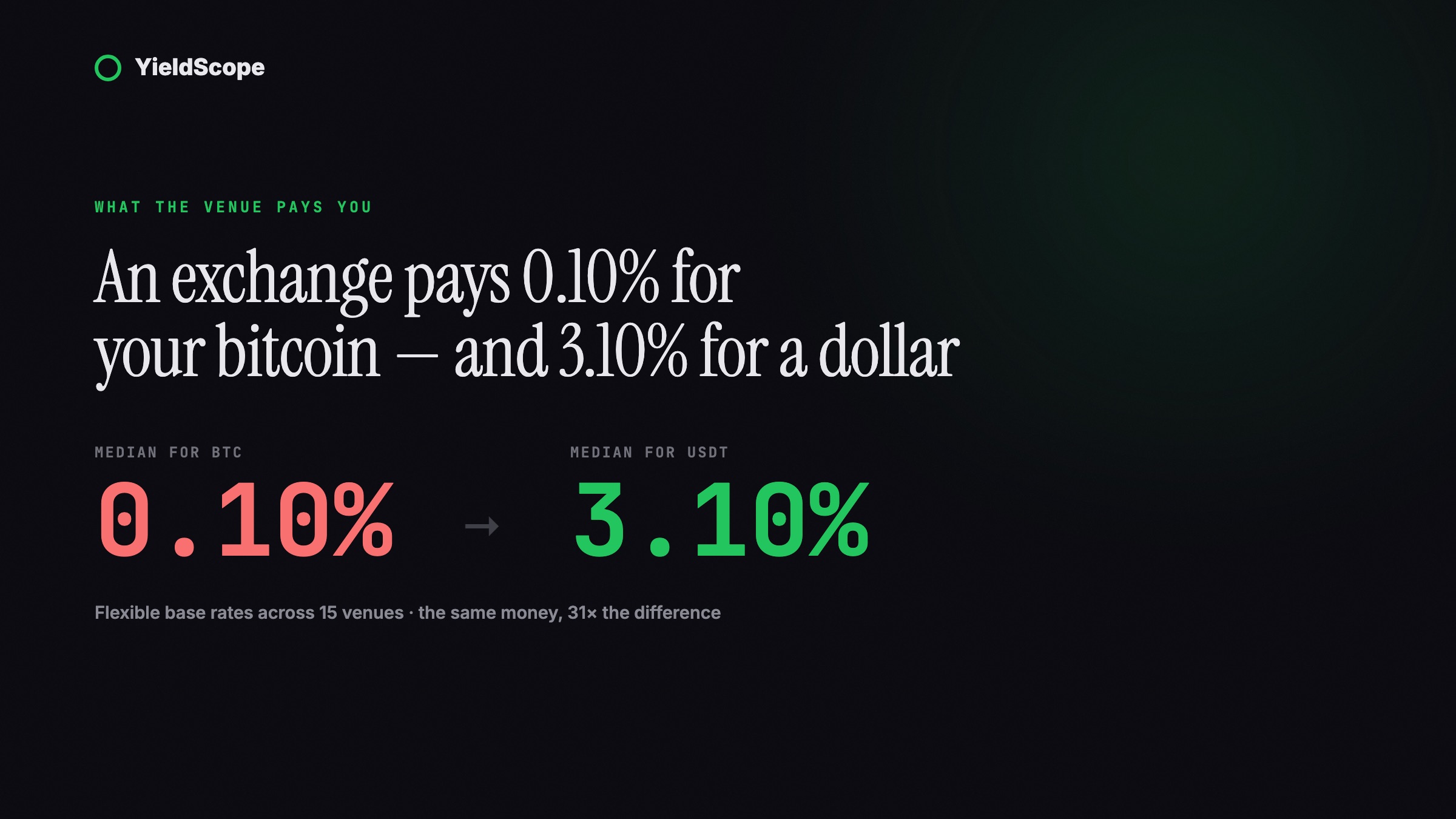
Across the fifteen venues that publish a flexible bitcoin rate, the median is 0.10% a year. For a dollar stablecoin on the same venues, it is 3.10%. Same platform, same account, same withdraw-anytime terms — thirty-one times the difference. What you hold decides what you earn, far more than where you hold it.
Ask an exchange what it pays on idle balances and you get a page full of numbers. What that page rarely makes obvious is how differently it treats the two things most people actually hold.
We track every flexible earn product across roughly forty venues. Pulling out three coins — bitcoin, ether and Tether's dollar — gives an unusually clean picture.
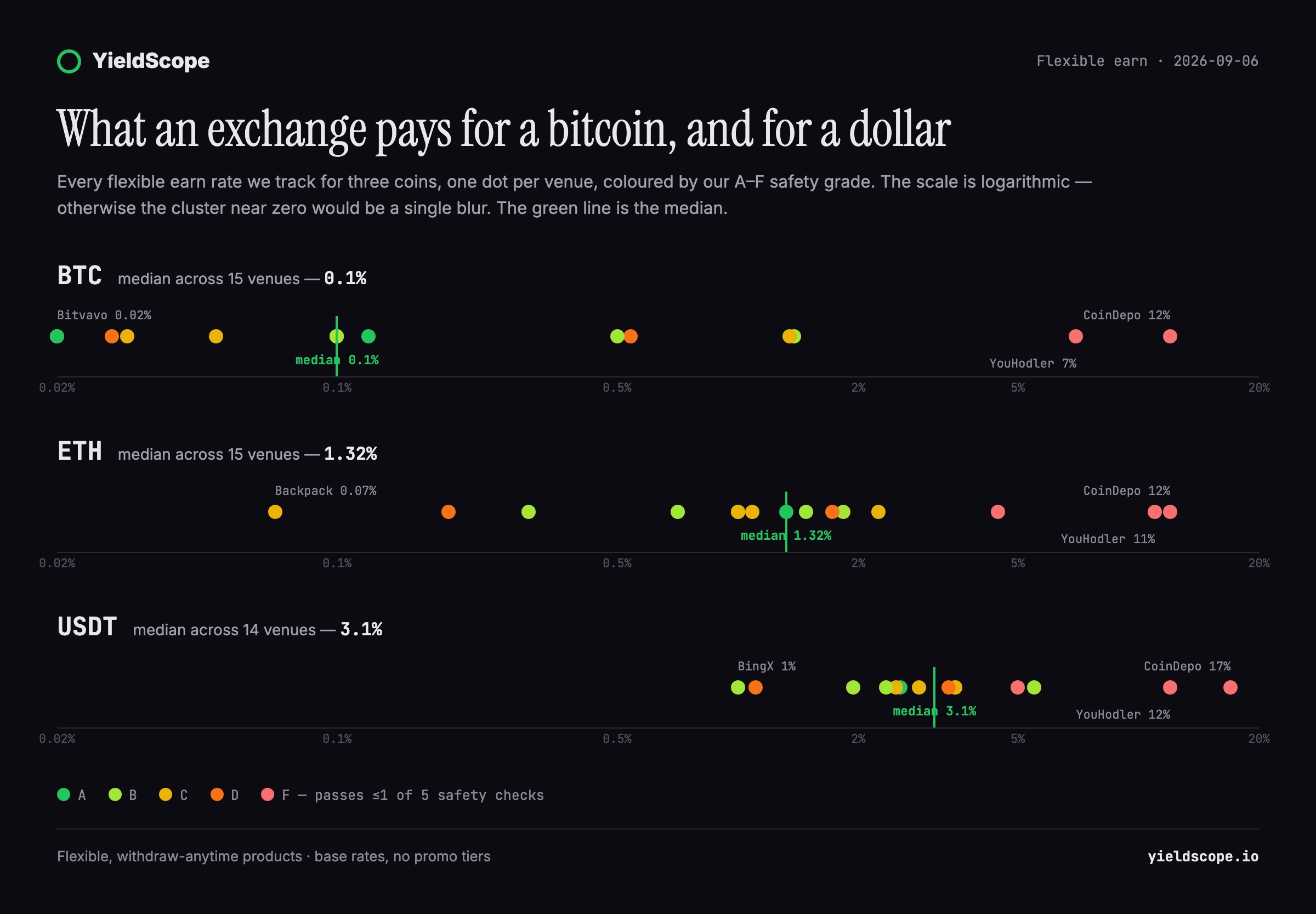
The three medians
- BTC — 0.10% across 15 venues.
- ETH — 1.32% across 15 venues.
- USDT — 3.10% across 14 venues.
On a $10,000 balance held for a year, that is roughly $10 for bitcoin against $310 for the dollar stablecoin. The bitcoin figure is close enough to nothing that it will not cover the network fee to move the coin twice.
Look at the shape of the bitcoin row in the chart. Almost every venue clusters at the far left, between 0.02% and 0.5%. Bitvavo pays 0.02%. Binance pays 0.02%. KuCoin pays 0.027%. Kraken, Gate and BingX all sit at 0.10%. These are not obscure platforms cutting corners — they are the largest venues in the business, and they have collectively decided that your bitcoin is worth about one tenth of one percent a year to them.
Why the gap exists
This is not stinginess. It is what the two assets are used for.
When you leave a stablecoin on an exchange, there is a queue of people who want to borrow it: traders opening leveraged positions, market makers funding inventory, arbitrageurs closing spreads. Dollars have a rental market, and the rate you receive is a cut of what borrowers pay.
Bitcoin has far less of one. Most people who want bitcoin exposure buy the coin; they do not borrow it. The main borrowers are those shorting it, and that demand is thin and cyclical. Nobody is bidding for your bitcoin, so nobody pays much for it.
Ether sits between the two, and for a specific reason: it can be staked. The 1.32% median is closer to a share of network staking rewards than to a lending rate.
Who pays a lot for bitcoin, and what that tells you
Two venues break the pattern. CoinDepo pays 12% on bitcoin. YouHodler pays 7%. Both carry an F in our grading — each passes at most one of our five safety checks.
That correlation is the whole point of the chart's colour coding. Look at the bitcoin row again: every dot on the right-hand side is red. Not one A-grade or B-grade venue pays above 1.38% on BTC.
When the entire market prices an asset at a tenth of a percent and one platform offers seventy times that, the extra is not a better business model. It is compensation for a risk the other platforms are not asking you to take — and the safety grade usually says which one. A venue that keeps no proof of reserves, publishes no audits and has no track record can promise any number it likes; the promise costs nothing to make.
The same applies to the dollar row, where CoinDepo's 17% and YouHodler's 12% sit far to the right of Kraken's 5.5%. The gap between an F-grade rate and a B-grade rate is not free money. It is the price of the checks the F-grade venue does not pass.
The spread inside a single exchange
There is a second finding, and for anyone choosing where to park money it may matter more than the first.
The distance between the lowest and the highest flexible rate inside one venue is enormous:
- Binance — from 0.01% to 40.66% across 201 flexible products. The median is 0.87%.
- Bitget — from 0.12% to 331.95% across 217 products. The median is 1.00%.
- KuCoin — from 0.01% to 18%. The median is 0.04%.
- OKX — from 0.5% to 92.7%. The median is 9.34%.
Read those medians again. On Binance, the typical coin pays under one percent a year. On KuCoin, the typical coin pays four hundredths of a percent — functionally zero, across sixty-nine products.
The headline rates on the front page come from a handful of small, volatile tokens at the top of a list of two hundred. Whether you earn 0.01% or 40% on the same exchange, in the same account, is decided entirely by which coin you happen to hold.
On-chain, the same pattern holds
If the gap were an exchange business decision, DeFi would look different. It does not.
Across the 535 pools we track, the median stablecoin pool pays 4.27% and the median bitcoin-denominated pool pays 0.53%. Wrapped bitcoin sits in lending markets earning almost nothing there too, for the same reason: nobody wants to borrow it.
The on-chain stablecoin median is higher than the exchange median — 4.27% against 3.10% — which is what you would expect once you remove the venue taking a cut. You pay for that in a different currency: smart-contract risk, no support desk, and no one to appeal to if a contract is drained.
The number the crypto rate should be measured against
A stablecoin paying 3.10% sounds unremarkable until you ask what the alternative is, and unremarkable is exactly the right reaction.
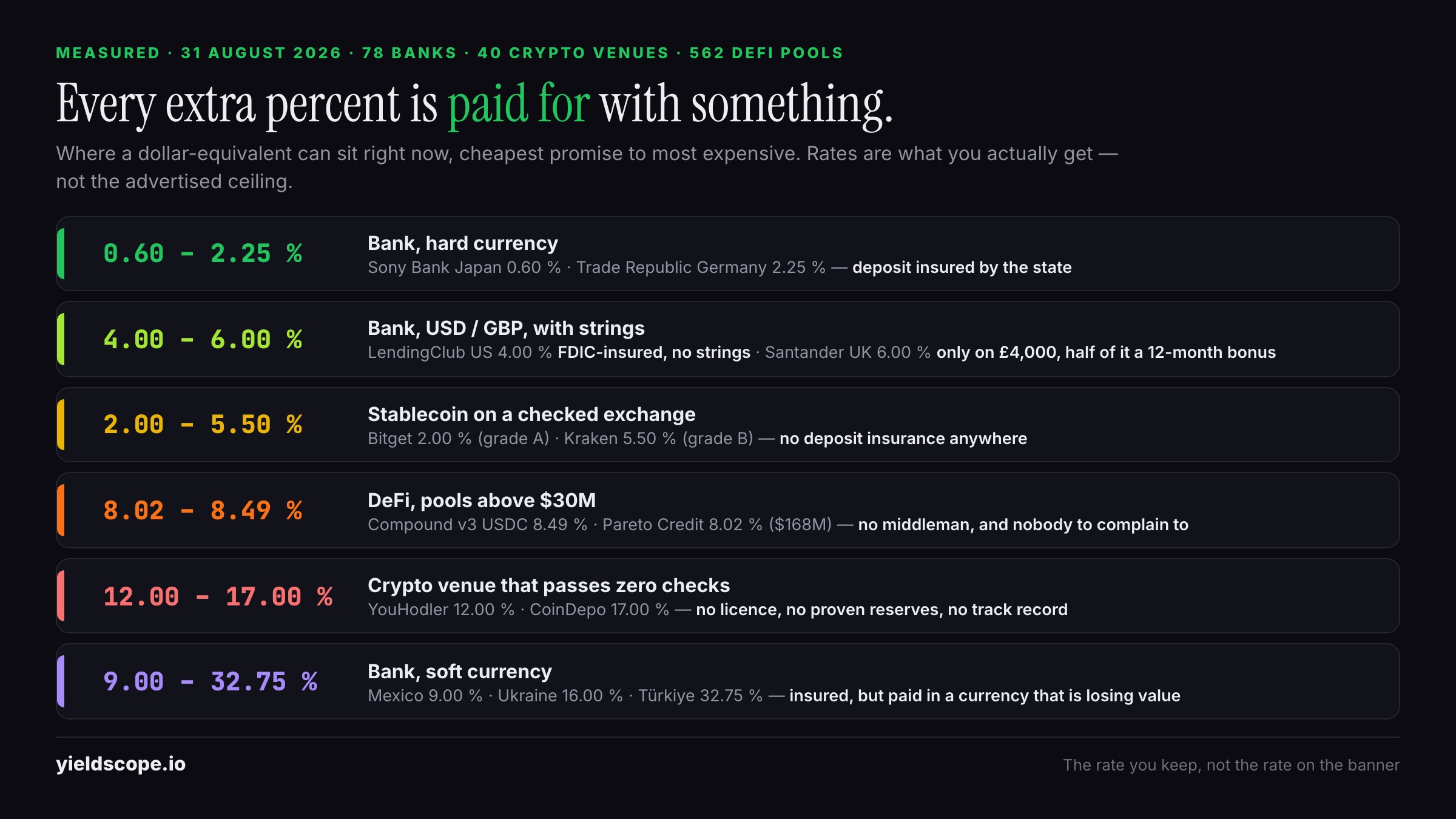
An insured US savings account currently pays up to 4.00% — LendingClub and Revolut both sit there, EverBank at 3.90%, Bask Bank at 3.75%. Those are dollars in a bank, covered by federal deposit insurance up to $250,000, with no exchange between you and the money.
So the median exchange stablecoin rate is below what an ordinary American savings account pays, while carrying platform risk that no deposit insurance covers. The 5.5% at Kraken beats the bank. The 3.10% median does not.
Note, 23 September 2026: the 5.5% for USDT at Kraken was entered in June and not re-checked after: our collector could not see Kraken's Opt-In Rewards. Kraken's own support page (17 Sep 2026) gives its flexible rate on USDT as 4.00%, with 5.60% only on an 18-month fixed term, and the product is not offered in the US or the EEA. At 4.00% Kraken only matches the best insured US savings rate quoted here; it does not beat it.
That comparison is worth keeping in your head whenever a rate looks reasonable. "Better than nothing" is not the bar. "Better than an insured deposit, by enough to pay for the extra risk" is the bar.
Where crypto genuinely wins is the top of the safe range and access: 5.5% on a B-grade venue, available in countries where a US savings account is not, with no minimum balance and no residency requirement. That is a real advantage. A median of 3.10% is not it.
What this means in practice
Sorted by what we can actually see in the data:
- If you want yield, hold something with a rental market. Dollar stablecoins have one. Bitcoin does not. This is a property of the asset, not a feature you can shop around for.
- Do not switch exchanges chasing a bitcoin rate. The difference between the best and worst A-to-C-grade venue on BTC is 1.38% against 0.02% — on $10,000 that is $136 versus $2 a year. Real, but small, and not worth moving custody for.
- Do check which coin you are being quoted on. A venue advertising "up to 40%" is quoting a token you have probably never held. Your actual coin is somewhere in the middle of a two-hundred-row table.
- Treat an outlier bitcoin rate as a question, not an offer. Ask what the venue does with your coin to fund 12% when the rest of the market pays 0.10%, and whether it publishes proof of reserves. If the answer is not on the site, that is the answer.
Our method
Every rate here is a base flexible rate, read off the venue's own product page — withdraw-anytime products only, no fixed terms, no promotional tiers, no aggregators. Grades come from five checks: regulation, proof of reserves, flexible withdrawal, an insurance fund, and track record.
You can see every venue with its grade in the safety ranking, and the full rate table for any coin on its own page — for example USDT or BTC.
Rates float and were captured on the date shown in the chart. Not financial advice.
Educational content, not financial or legal advice. Sources are linked in the text.