Yield
YieldThe SpaceX IPO, fully decoded: the biggest listing ever — expectations, the first hours, and what comes next
A professional breakdown of the SpaceX IPO (June 12, 2026): what the market expected, the 24-year road to the listing, how the first hours of trading played out, and the full bull-vs-bear case. Verified numbers only.
On June 12, 2026, SpaceX went public on the Nasdaq under the ticker SPCX — and instantly became the largest IPO in history. It sold 555.6 million shares at $135, raised $75 billion (beating the old Saudi Aramco record), and closed its first day worth more than $2.1 trillion. Here is the breakdown without the hype: what was expected, the 24-year road to the listing, how the first hours played out, and the real case for and against.
What the market expected
Shares were priced at $135, implying a valuation around $1.77 trillion. A week earlier the Financial Times had floated $1.5 trillion. Demand was enormous: the book was more than 4× oversubscribed, with total investor interest above $250 billion.
Analysts, though, disagreed wildly — and that matters:
| Who | Valuation / target | Stance |
|---|---|---|
| Morningstar | $780B ($63/share) | Bearish — "55% overpriced" |
| IPO price | $1.77T ($135) | — |
| Day-1 close | $2.1T ($161) | — |
| Oppenheimer | $195/share, Outperform | Bullish |
| ARK Invest (base, 2030) | ~$2.5T | Bullish |
| ARK Invest (bull, 2030) | ~$3.1T | Super-bull |
The spread on "fair value" runs from $780B to $3.1T. That is not a consensus — it is a bet on belief.
24 years to the launchpad
SpaceX did not appear overnight. The road from startup to trillions took almost a quarter-century:
| Year | Milestone | Valuation |
|---|---|---|
| 2002 | Company founded | ~$27M |
| 2008 | First successful Falcon 1 launch | ~$0.4B |
| 2012 | Dragon docks with the ISS | ~$2.4B |
| 2015 | First Falcon 9 booster landing | $12B |
| 2019 | First Starlink satellites launched | $33B |
| 2021 | Crew Dragon flies NASA astronauts | $100B |
| 2024 | Tender rounds | $350B |
| 2025 | Secondary sales | $800B |
| 2026 Feb | Merger with xAI | $1.25T |
| 2026 Jun | IPO (close) | $2.1T |
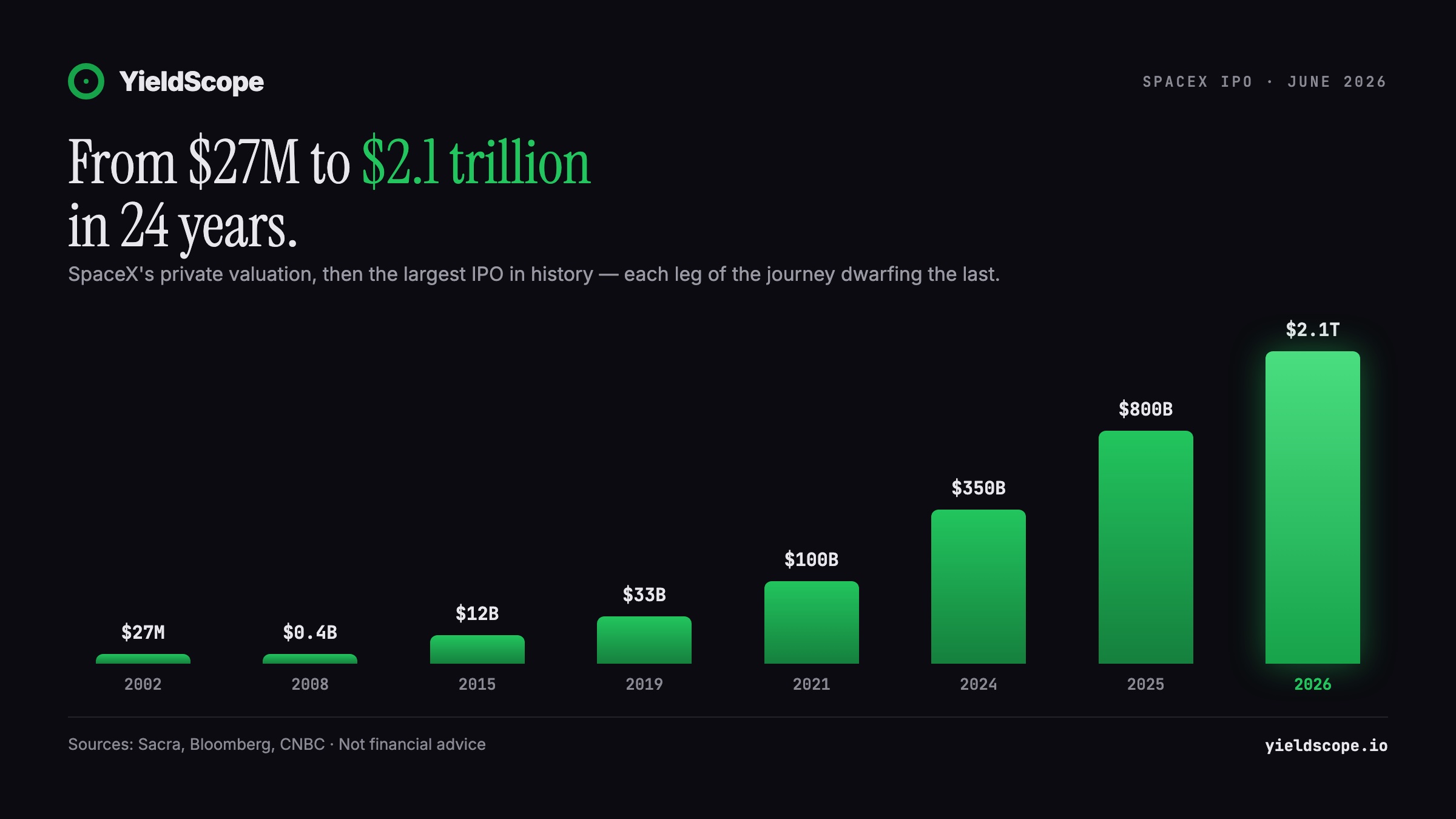
Why so long? For years Musk insisted he would only list SpaceX once Mars flights were routine — he did not want the "quarterly pressure" of public markets. Three things changed his mind: the AI-infrastructure boom (plans for orbital data centers), the need to fund a loss-making xAI, and the chance to give investors a single way to bet on space and AI at once.
The first day of trading
The June 12 timeline:
| Metric | Value |
|---|---|
| IPO price | $135 |
| Open | $150 (+11%) |
| Intraday high | $176.52 |
| Intraday low | $149.34 |
| Close | $160.95 (+19%) |
| Market cap | >$2.1T |
One detail trips up even the press: $176.52 was the intraday high, not the closing price. The stock closed at $160.95 — up 19% from the offer, strong but well off the day's peak. That move officially made Elon Musk the first person in history worth roughly $1 trillion (his SpaceX stake alone is over $766B).
A subplot worth knowing: the SPCX perpetual futures that crypto exchanges traded before the IPO. In late May they ran above $220. Anyone who bought the peak was down 25–30% by the listing — even though the stock opened up at $150. A textbook hype trap: the anticipation cost more than the fact.
Where SPCX stands now
A couple of days after the debut, the stock holds around $160–161 with no real pullback. Next come the index inclusions (passive-money inflows):
- FTSE Russell — after the close on June 26 (fast-entry rule for the largest names).
- MSCI — effective June 29.
- S&P 500 — not yet: that requires four straight quarters of GAAP profit, and SpaceX posted a $4.9B loss for 2025.
The bull case
- Starship V3. Its first flight (May 22, 2026) was a partial success. Cheap heavy lift is the key to next-gen Starlink satellites and NASA Artemis contracts ($2.9B + $1.15B).
- Starlink is scaling. Subscribers went 2.3M (2023) → 4.4M (2024) → 8.9M (2025) → 10.3M (March 2026), across 164 countries. The segment is already profitable (~39% operating margin).
- Orbital data centers (AI1). Anchor customers for space-based AI infrastructure are claimed; first hardware launches in 2027.
- Government contracts. ~$22B in accumulated federal contracts (NASA, Space Force, Starshield).
- Projections. Goldman Sachs models ~$474B in revenue by 2030 (from $18.7B in 2025). That forecast is the load-bearing wall of the bull valuation.
The bear case
- Key-person risk. Musk is simultaneously CEO of Tesla, SpaceX, xAI and X. The S-1 calls this the "primary risk."
- Starship isn't reliable yet. Without rapid reusability, orbital data centers don't pencil out. Morningstar puts the odds of the bull case at roughly 7%.
- xAI is a drag. xAI's 2025 operating loss was $6.36B — it is what flipped SpaceX from a $791M profit in 2024 to a $4.9B loss in 2025.
- A stretched multiple. Around 94× sales (for context: Nvidia ~23×, Palantir ~67×). J.P. Morgan notes the average IPO this decade jumped +32% on debut day but fell −26% versus its offer price within a year.
- Competition and regulation. Blue Origin, Amazon Kuiper, Rocket Lab; FAA/FCC limits on launch cadence and orbital density.
What to watch next
Three triggers for the coming months: (1) the reliability of Starship V3 flights, (2) whether xAI's revenue trajectory justifies Goldman's forecast, and (3) how the stock behaves after the Russell (June 26) and MSCI (June 29) inclusions bring passive funds in.
The takeaway is simple: SpaceX is at once the best engineering story of the decade and one of the most expensive public companies by multiple. Both are true. The $135 price assumes near-flawless execution for years; any stumble at Starship or xAI, and the market will reprice fast.
We track market events with the same honesty we use to grade exchanges: the reward and the risk always sit side by side. Our day-one recap is here: SpaceX, one day later.
Not financial advice. Data as of June 14, 2026; figures verified against Reuters, Bloomberg, CNBC, NPR and the SEC S-1 filing.
Educational content, not financial or legal advice. Sources are linked in the text.