Yield
Yield60 Days and 44,296 Snapshots: What the Data Actually Says About Crypto Yield
For two months we logged every rate across 37 platforms daily. The results: 126 rates spiked above 60% APY — 67% died within a day; the record 499% lasted one day; 30% of rates never changed at all; the median F-graded rate is 12× the A-graded one. Full breakdown with numbers.
On May 25, 2026 we started doing something obsessive: writing down every crypto yield rate we could reach, every single day. Sixty days later the database holds 44,296 rate snapshots across 1,630 platform × coin pairs on 37 platforms — from Binance and Kraken to niche lenders most people have never heard of.
This article is what those two months actually taught us. Not vibes, not marketing — counts, medians and survival times. Every number below comes from our own daily tracking; the live board updates from the same pipeline.
The dataset in one paragraph
Each day our sync captures the publicly displayed earn rate for every platform × coin pair we track — base tiers only, never the "up to" teaser with a token boost and a 90-day lock buried in the footnote. Where a platform publishes tiers, we record what an ordinary depositor gets. That policy matters for everything that follows: the gap between advertised and base rates is where most of the industry's noise lives.
Anatomy of a spike: the one-day lifespan
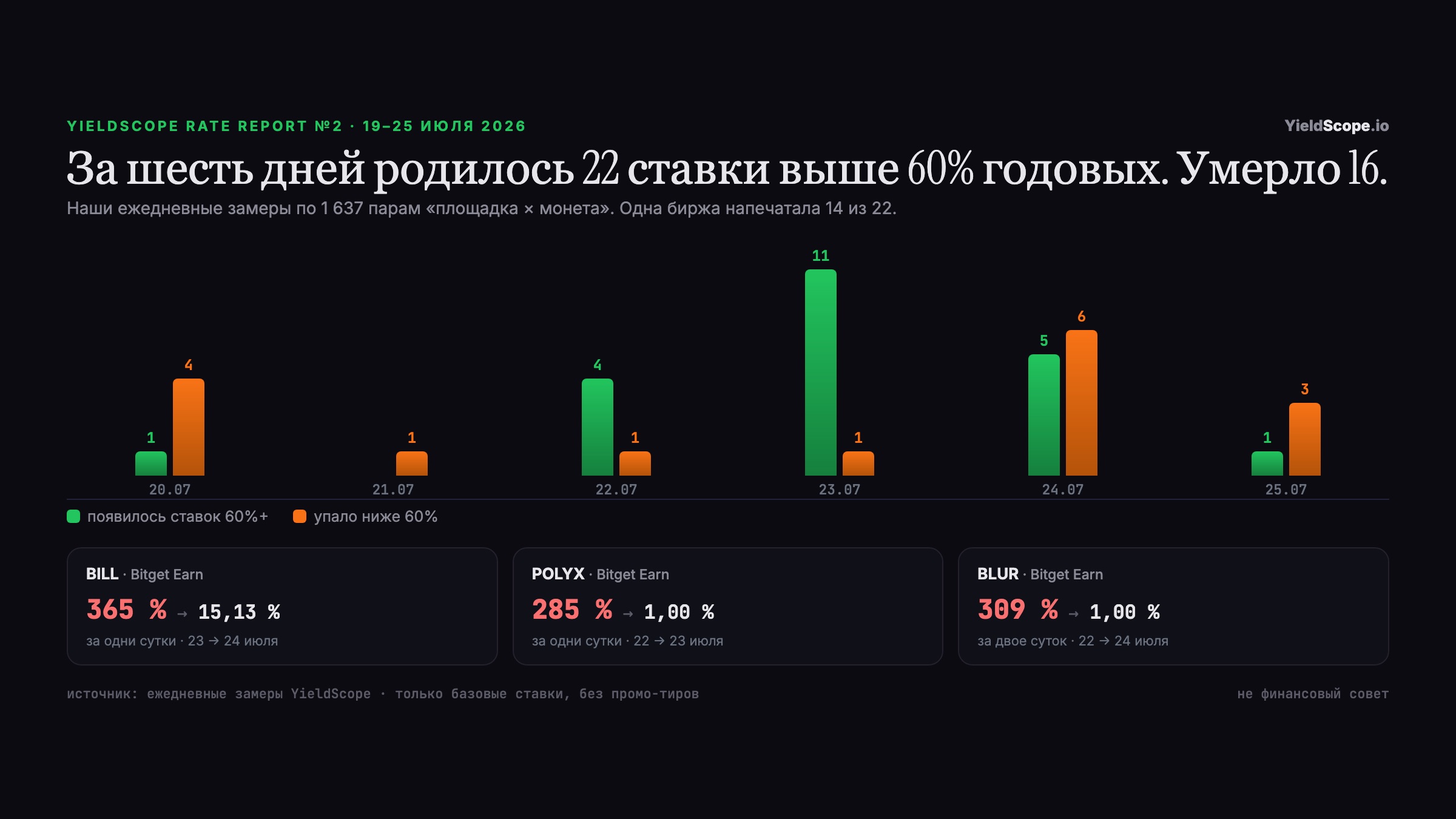
Over 60 days, 126 rates spiked above 60% APY at some point. What happened to them?
- 101 of the 126 have already died (dropped back below 60%).
- 67% died within a single day.
- The median lifespan of a 60%+ offer is exactly one day.
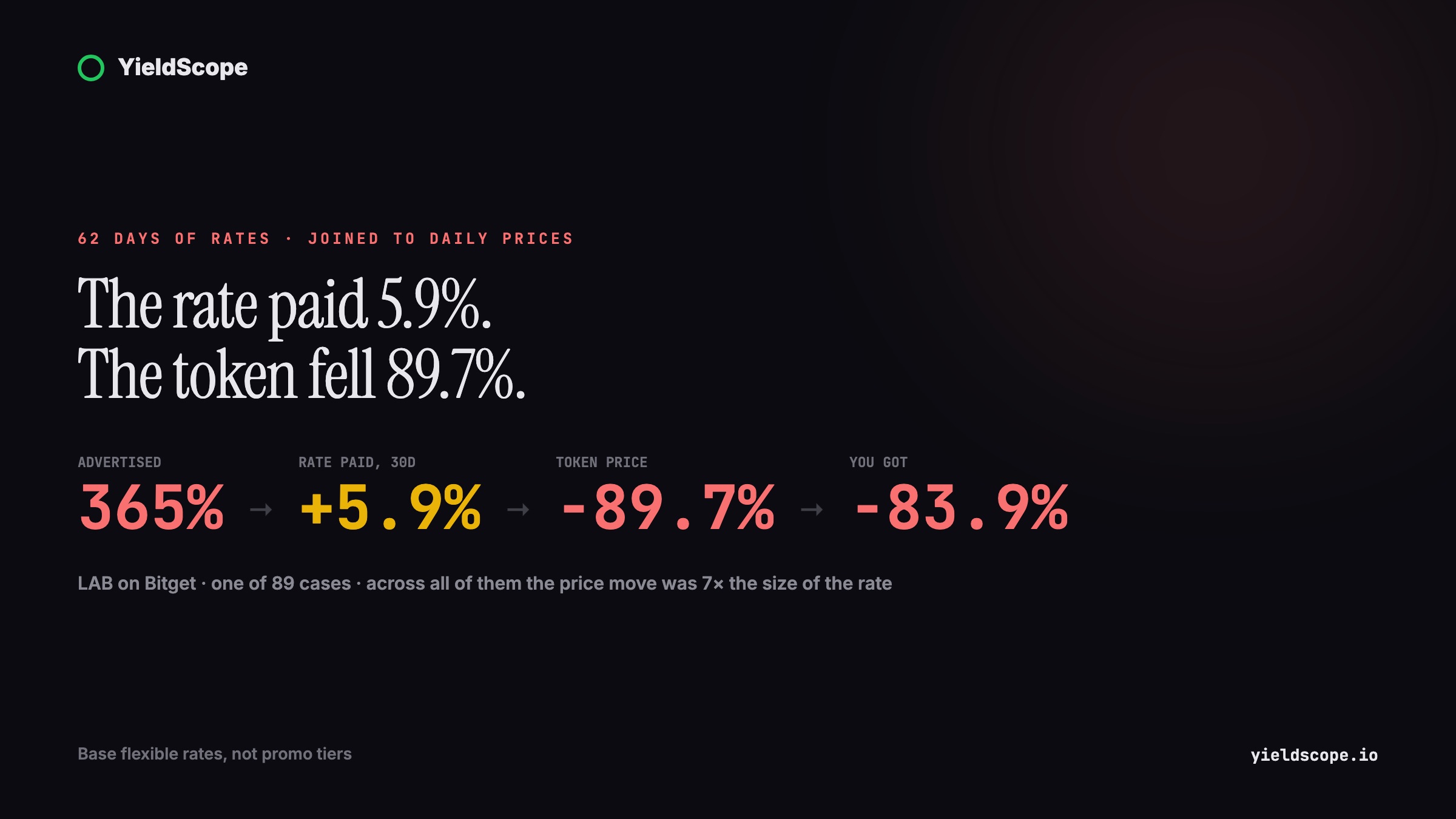
This is the single most practical fact in our dataset. A triple-digit APY on a promo banner is not a market rate — it is a marketing event with the shelf life of a mayfly. By the time a screenshot of it reaches you, the rate is usually already gone; the pool cap was filled by bots and insiders in the first hours.
A fresh example happened while we were writing this. Yesterday one exchange printed a brand-new 365% APY on ZIL — it was paying 1% the day before. This morning that rate is 13%. One day. Right on the median.
The record: 499.81% — for exactly one day
The highest rate we ever logged was 499.81% APY on RE (Gate, June 24). It appeared in our morning snapshot, and by the next one it was gone. Nobody who saw that number in an ad and went through registration, KYC and a deposit had any realistic chance of catching it.
The current champion of persistence in the extreme zone is different: a 365% APY that survived 12 straight days before being cut — the longest triple-digit run in our data. Even the best case in this category lasts under two weeks.
Who runs the printer
Spikes are not evenly distributed. Counting every 60%+ event by platform:
| Platform | Spikes born | Already dead |
|---|---|---|
| OKX | 39 | 36 |
| Bitget | 36 | 25 |
| Bybit | 26 | 23 |
| Gate | 14 | 14 |
| Binance | 1 | 1 |
Four platforms account for over 90% of all extreme-rate events. This is a business model, not an accident: rotating short-lived promo rates across small-cap coins generates a constant stream of "365% APY!!" screenshots for social media at a very modest real cost — remember, the pools are capped and most die in a day.
Binance's single spike in two months is worth noting too: the largest exchange in the world apparently does not need the printer.
The third of the market that never moves
Here is the number that surprised us most: 458 of 1,508 pairs with enough history — 30% of the entire market — did not change once in 60 days. Not a single basis point.
Crypto yield has a reputation for volatility, and the promo segment deserves it. But beneath the fireworks there is a large, silent, stable layer — mostly conservative rates on major platforms. The two longest unchanged streaks in our data are both on OKX: XAUT (tokenized gold) at 11% and USDT at 2.5%, each 48 days without a move. Our favourite boring champion, USDT at 5.5% on Kraken (safety grade B), has now held for 30 straight days — exactly half the project's lifetime.
Note, 23 September 2026: the 5.5% for USDT at Kraken was entered in June and not re-checked after: our collector could not see Kraken's Opt-In Rewards. Kraken's own support page (17 Sep 2026) gives its flexible rate on USDT as 4.00%, with 5.60% only on an 18-month fixed term, and the product is not offered in the US or the EEA. The 30-day streak is that figure carried forward, not an observed stable rate.
The grade paradox, updated
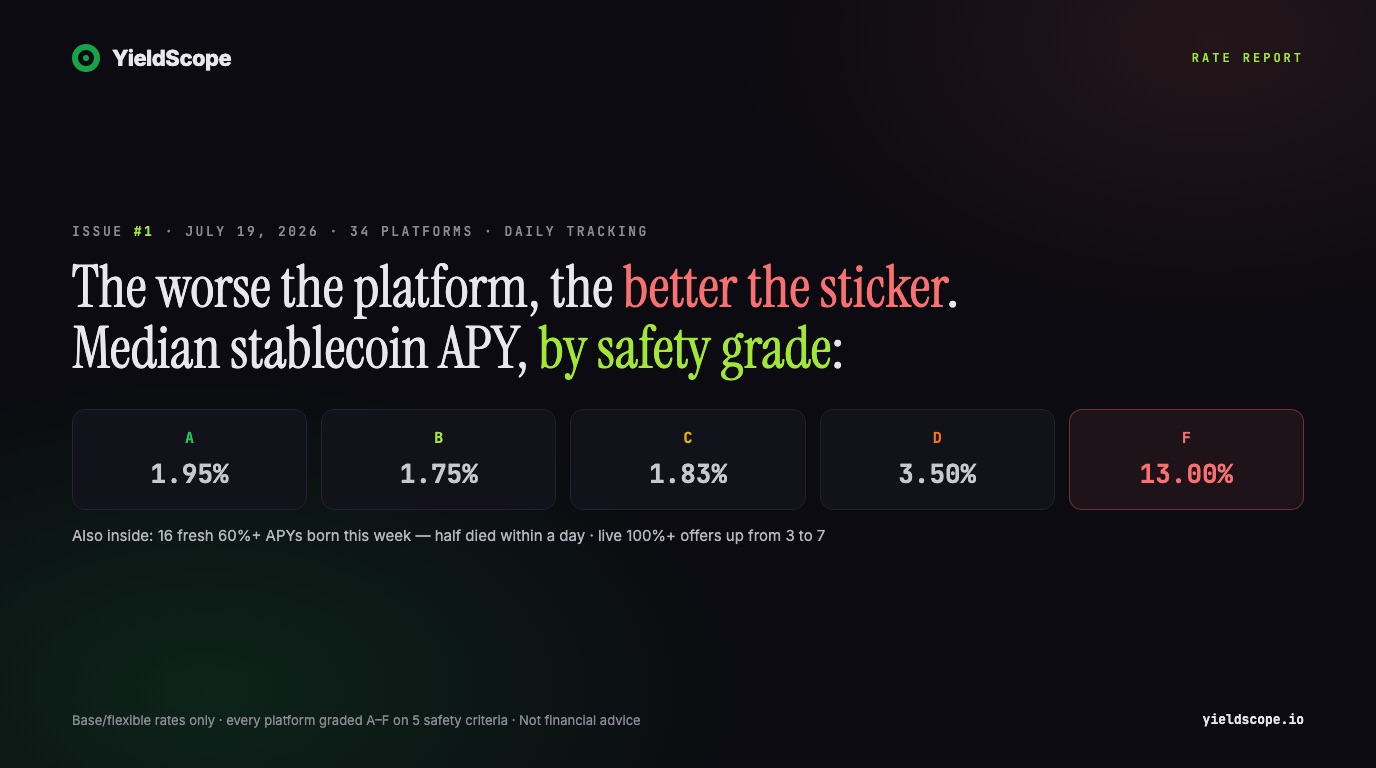
We grade every platform A–F on five public safety criteria — regulation, proof-of-reserves, withdrawal flexibility, insurance, track record (the methodology is public). Two months of data keep confirming the pattern we first showed in Rate Report #1:
- Median rate on A-graded platforms: 1.0% APY.
- Median rate on F-graded platforms: 12.0% APY.
Twelve times the yield — and the price is failing every single safety check we run. There is no free lunch in this dataset anywhere: the extra percent is always paid for with regulation you don't get, reserves nobody proves, locks you didn't read about, or a track record that doesn't exist.
Volatility tells the same story from another angle: A-graded rates barely move (median variation ~3% of the rate), while B and C platforms swing their rates by a quarter to a third over the period. The safest rates are not just lower — they are also far more predictable, which matters if you are actually planning around the income.
What we take away from 60 days
1. Treat any rate above ~30% as an event, not an offer. Median survival of one day means you will almost never capture it, and the platforms printing them know that.
2. The boring layer is real and investable. A third of the market doesn't move for months. Stablecoin rates of 5–7% on B-graded platforms have persisted the entire life of this project — that, not the fireworks, is the actual yield market.
3. Read the grade before the number. A 12× yield gap between F and A platforms is not alpha — it is the market pricing the risk for you. The number on the left of our table means nothing without the letter on the right.
We'll keep logging every day. Day 120 report will tell us whether these patterns hold through a full quarter — subscribe on the stablecoins board or follow the weekly digest to catch it.
Data: YieldScope daily tracking, May 25 – July 23, 2026; 44,296 snapshots, 1,630 platform × coin pairs, 37 platforms. Base/flexible rates only. This is not financial advice.
Educational content, not financial or legal advice. Sources are linked in the text.